Wednesday, August 31, 2011
Irene
This past weekend, 8/28/11, we had a bit of a storm work it's way up the east coast. On Thursday morning, 8/25, it hadn't made landfall in North Carolina yet and the projected storm track showed it hugging the coastline but staying in the Atlantic after crossing part of North Carolina. The winds were a steady 110 knots, gusting higher. If it stayed on this course I felt like we'd be OK at our marina because we'd be far enough from the storm that the winds would be less than 65 knots and the wind direction wouldn't cause serious flooding.
At noon that day I checked the National Hurricane Center's website and the update now showed Hurricane Irene coming inside the Chesapeake Bay with 100 knot winds. Double Yikes! I'm not kidding, my hair stood on end. This was a whole different game. Storm surge would be a serious problem with water being pushed into our creek from the Bay. In 2003 Hurricane Isabel brought a storm surge of over 7.5' to our creek. Once I got my hair back under control I left work early and headed home. When I got to the marina I put our boat on a list to have her hauled and stored on the hard. This costs about $700 but insurance pays for half so it's not too bad. I was told we had about 100 boats ahead of us and chances were pretty slim of us getting hauled. OK, it's worth a shot.
I figured I had about 48 hours to get ready for the worst. I hadn't been through this drill before so I didn't know how much time I needed to get ready. I started that afternoon by removing the Bimini and Dodger canvas. This gave me access to the solar panels. I felt it was a good idea to get them down because it was a good chance that they'd catch that 110 knot wind and rip the Bimini frame right off the boat. Once I had all that removed I tied down the frame. We removed the Genoa and Staysail and rolled the Main up (furled) inside the mast as tight as she would go. The idea here was to reduce the area exposed to the wind as much as possible
By Friday morning we got another update on the storm and now they were saying it would track out to the Atlantic, just as they had said originally. In addition to that they thought the winds would be reduced to about 85 knots. If it holds to that then we'd be OK. We had already done more than was necessary but I figured it was better to be safe than sorry. We doubled up all our dock lines and prepared things down below as if we were going out sailing.
On Saturday the marina informed us they'd be shutting off the water at noon and the power at 1700. OK, guess we won't even have to consider sticking around. At this point the storm was working it's way across North Carolina. The sky was overcast but we had no rain yet and just a light breeze. My sister and brother-in-law, Ellen and Ed, offered us refuge at their place, which we gladly accepted. Thanks guys, we really appreciate it. We got to their place around 1500 and the rain was just starting. We all hunkered down in front of the TV and watched the news reports. This was a big mistake because those reporters are more interested in drama than giving the real story so they tend to exaggerate like crazy. I'm sitting there listening to these goons and by 2300 I couldn't take it anymore. The storm was supposed to peak in our area around 0200 Sunday morning and I just had to get down to the boat and see how she was doing. I mean, the wind was blowing straight across the Bay and the water could be high at the dock requiring an adjustment of the dock lines. Or the bilge pump coulda failed and I needed to be down there to bail. That boat is our home, has everything we own aboard and I just couldn't sit there and listen to those idiots on TV anymore.
The three of us, Cheri, me and Bella, piled into our car and cruised on down. The rain was coming down in sheets and the windshield wipers were on full blast and could hardly keep up. The wind was blowing pretty good too. Luckily we were just about the only car on the road so I felt pretty comfortable driving 45 MPH on the the Baltimore Beltway and then down Rte 97 into Annapolis. We got on Rte 2 and headed south and as soon as we got out of Edgewater we saw flashing lights. Trees were down across the road. There was a cop there but as we drove up he cut around the tree and headed south at 35 MPH. Well what else could we do but follow? We had a police escort all the way down to Deale. Cool! Along the way we had to drive around several more downed trees but it wasn't really dangerous or anything. Just kinda surreal. We got to the marina around 0030, grabbed a flashlight and walked down to the boat. As we walked down the dock we were relieved to see that the water level was pretty normal. This was a big relief for me because I figured as the storm went further north the wind would veer around out of the north and drive the water out of the Bay, meaning less chance of flooding as the storm progressed. So we were already pretty much out of danger from storm surge. I think the wind was blowing about 65 knots steady at this point and the rain was now coming down even harder. When we got to the boat she was sitting in the center of the slip, heeling over with the wind but in absolutely no danger. I shined the light up and down her length, didn't see anything wrong and decided to head back. Three hours of driving, up and back, for a two minute visual confirmation. In that two minutes we were totally soaked to the skin. It was worth it, let me tell you, just for the peace of mind. We got back safely around 0230 and climbed into bed and slept like babies.
Looking back on things now I can see that I totally over-reacted and did way more than I had to. We could have left the sails and canvas on as well as the solar panels. It was right to have doubled up on the dock lines and securing for sea down below was definitely a good idea too. I don't regret having done too much because if I hadn't then the storm woulda come right up the Bay and clobbered us. I'm pretty sure that's how that works.
Wednesday, August 17, 2011
Living With Doctor Dolittle
Monday evening I got home from work around 1830. It had been raining on and off all day and I could see some pretty dark clouds approaching from the south-west as I walked down the dock. When I get aboard I find that the holding tank needs to be pumped out. We have contracted with a service to do this every other week and that's worked out real nice but this time we need to take care of it ourselves. No problem, we just need to beat that storm that's drifting our way.
In record time we get the boat underway and head over to "C" dock. As we pull up alongside we notice a commotion on the dock. There's a big old bird dancing around with his wings spread out. As we tie up the bird backs away and falls off the dock into the water. We race over to see what he's doing and it's obvious this guy is gonna drown if we don't do something. Cheri grabs a net from our boat and angles it down towards the bird who grabs onto the rim and hangs on for dear life. We pull him back up on the dock and set the net down and back away real slowly. This bird is an adult Osprey with a wingspan of about 5' and talons as long as my fingers. Yowza! The bird is pretty freaked out and screams and dances around, eventually falling back in the water. We fish him out again and this time he just stands there, screeching with his wings spread out.
So now what do we do? His movements make me think that his right wing is injured because he keeps holding the one wing out and folding up the other. Cheri goes down below and starts making phone calls to see if she can get a Vet to come out and help. No luck there but she eventually gets hold of the Maryland Dept. of Natural Resources and they direct her to a raptor rescue lady (chick?) down in Solomons Island, about 40 miles away. She can't come up tonight and asks us to put the bird in a box and keep it for her. What? Put this monster with 4" claws in a box? Yikes!
Cheri wanders off looking for a box and I go back and take care of the boat. The bird is only about 15' away while I'm working on the boat so I move around very slowly so I don't frighten him. I still hafta get the holding tank pumped out before this storm hits and it's now getting dark too. I finish up just as Cheri returns with a big box which she sets down beside the Osprey. By now there's another boater, an old English dude with lots of suggestions and no intentions of assistance, and Miguel, the 6'6" security guard who also has no intention of going near the bird. Cheri picks up the net, which the Osprey is still hanging onto and sets him down in the box. I throw a towel over his head and he instantly goes quiet and stops moving around. This is good but his gigantic wings are still sticking out. Cheri takes one and gently folds it into the box and I do the same with the other. As I push his wing into the box I picture his big old beak ripping the flesh off my hand but the bird just quietly sits there under the towel. This is much easier than I ever woulda imagined.
We can't put the bird on our boat because Bella would just go nuts and then the Osprey would probably eat her. There's already been enough excitement for one night. We pick up the box and put it in a cart. Miguel offers to take the cart down by the office for us so we could get La Vida Dulce back to her slip. Cheri writes up a note and pins it to the towel: "Injured Osprey in box". Yeah, that's a good idea. Can you imagine finding a box on your doorstep, lifting the towel and finding this gigantic bird of prey right in your face? She also included some info about it being picked up in the morning. Miguel found a good safe place for the cart under the stairs where it'd be protected from the storm and out of the way of critters.
I checked on the bird the next morning and he was doing fine. The rescue chick picked him up at 0900. Turns out she's related to one of the gals in the marina office. Small world. Actually, out here in the sticks, probably everybody is related in one way or another.
So, this isn't the first time Cheri has been involved with big birds and strange animals. She has a way with critters and they really respond to her. She's turned Bella into a circus dog. Down in Mexico she inched her way up to a Pelican on the beach and got within about 6" of it before it decided she was a nuisance. Throughout her life she's had all sorts of unusual pets, including a 6' Boa that got away from her when she was living in an apartment building and didn't show up for six months. During that time there were numerous reports of missing pets and small children. She's also had horses, Mynah Birds, Hermit Crabs and Koi as well as cats and dogs. Probably a lot more that I just can't remember right now.
I guess I might as well get used to this.
In record time we get the boat underway and head over to "C" dock. As we pull up alongside we notice a commotion on the dock. There's a big old bird dancing around with his wings spread out. As we tie up the bird backs away and falls off the dock into the water. We race over to see what he's doing and it's obvious this guy is gonna drown if we don't do something. Cheri grabs a net from our boat and angles it down towards the bird who grabs onto the rim and hangs on for dear life. We pull him back up on the dock and set the net down and back away real slowly. This bird is an adult Osprey with a wingspan of about 5' and talons as long as my fingers. Yowza! The bird is pretty freaked out and screams and dances around, eventually falling back in the water. We fish him out again and this time he just stands there, screeching with his wings spread out.
So now what do we do? His movements make me think that his right wing is injured because he keeps holding the one wing out and folding up the other. Cheri goes down below and starts making phone calls to see if she can get a Vet to come out and help. No luck there but she eventually gets hold of the Maryland Dept. of Natural Resources and they direct her to a raptor rescue lady (chick?) down in Solomons Island, about 40 miles away. She can't come up tonight and asks us to put the bird in a box and keep it for her. What? Put this monster with 4" claws in a box? Yikes!
Cheri wanders off looking for a box and I go back and take care of the boat. The bird is only about 15' away while I'm working on the boat so I move around very slowly so I don't frighten him. I still hafta get the holding tank pumped out before this storm hits and it's now getting dark too. I finish up just as Cheri returns with a big box which she sets down beside the Osprey. By now there's another boater, an old English dude with lots of suggestions and no intentions of assistance, and Miguel, the 6'6" security guard who also has no intention of going near the bird. Cheri picks up the net, which the Osprey is still hanging onto and sets him down in the box. I throw a towel over his head and he instantly goes quiet and stops moving around. This is good but his gigantic wings are still sticking out. Cheri takes one and gently folds it into the box and I do the same with the other. As I push his wing into the box I picture his big old beak ripping the flesh off my hand but the bird just quietly sits there under the towel. This is much easier than I ever woulda imagined.
We can't put the bird on our boat because Bella would just go nuts and then the Osprey would probably eat her. There's already been enough excitement for one night. We pick up the box and put it in a cart. Miguel offers to take the cart down by the office for us so we could get La Vida Dulce back to her slip. Cheri writes up a note and pins it to the towel: "Injured Osprey in box". Yeah, that's a good idea. Can you imagine finding a box on your doorstep, lifting the towel and finding this gigantic bird of prey right in your face? She also included some info about it being picked up in the morning. Miguel found a good safe place for the cart under the stairs where it'd be protected from the storm and out of the way of critters.
I checked on the bird the next morning and he was doing fine. The rescue chick picked him up at 0900. Turns out she's related to one of the gals in the marina office. Small world. Actually, out here in the sticks, probably everybody is related in one way or another.
So, this isn't the first time Cheri has been involved with big birds and strange animals. She has a way with critters and they really respond to her. She's turned Bella into a circus dog. Down in Mexico she inched her way up to a Pelican on the beach and got within about 6" of it before it decided she was a nuisance. Throughout her life she's had all sorts of unusual pets, including a 6' Boa that got away from her when she was living in an apartment building and didn't show up for six months. During that time there were numerous reports of missing pets and small children. She's also had horses, Mynah Birds, Hermit Crabs and Koi as well as cats and dogs. Probably a lot more that I just can't remember right now.
I guess I might as well get used to this.
Monday, August 1, 2011
The Endless Project List
Our boat, an Island Packet 420, has some beautiful exterior teak trim. On the side of the cabin, over the top of the ports, is a thin half-round strip called the "eyebrow" which runs on both sides all the way back to the cockpit. There's more to be found in the cockpit across the top of the coaming. Just in case you don't already know, the coaming is the raised wall around the cockpit that forms the back for the seats. It's real purpose is to keep water out of the cockpit but it also serves as an equipment platform (for winches), additional seating (for wenches), and a convenient, but hazardous, place to set your tools (for wrenches). The coaming on our boat is topped with a piece of teak about 1" thick, 4.5" wide and full length on either side of the cockpit. The majority of the exterior teak is in the toe-rail at the outer edge of the deck. This runs from the bowsprit (also teak) down both sides and across the stern. The toe-rail serves to keep things, such as tools and crew members, from sliding off the side of the boat. Ours also serves as a mounting surface for cleats and safety rails, as well as sealing the joint between the deck and the hull.
When we bought the boat the teak had just been refinished and looked really nice. Until now I've never had a boat that had teak with a varnish-like finish on it. My parents had a Dickerson ketch that had loads of teak but it was kept unfinished and we just scrubbed it all the time. In fact, back then we used a teak cleaner that was like Ajax or Comet cleanser and you just sprinkled some on and scrubbed it with a handbrush. Probably not considered environmentally friendly these days. Our last boat had some teak but it too was unprotected and we thought it looked just fine in it's weathered state. A good protective finish for exterior teak will have at least 6 coats. Our neighbors have 15 coats on their teak. It looks like ours had two, maybe three coats, just enough to make it look nice. Over this past winter it completely deteriorated and by the Spring it was looking really shabby with blotches of gray and black stains. Now our beautiful boat looked ratty and neglected.
While we were on vacation last month I finally decided to do something about the teak. That's right, this is how I spent my vacation. I can only sit around and relax for so long before I get bored and then I have to find something to do. Restoring the teak seemed like an excellent little project to take on. Got hold of some really cool stuff called Captain John's Boat Brite Soy Stripper. Put on a heavy coat of this stuff with a brush, let it sit for a few minutes and scape it off with a paint scraper. The finish lifts right off the wood with very little effort. Pretty amazing stuff. You want to work only on what you can do in about 45 minutes because the stripper will start to dry out after that and it makes things really difficult. I figured this one out the hard way, coated about 40' of toe rail and went back and started to scrape it off. I got through about 25' before it began to harden. After that I worked on sections, maybe 15' at a time, and that worked out much better.
So, I got one side and about half the bowsprit stripped and then the weather got really hot and muggy and stayed like that for the rest of our vacation. I went back to work and another week flew by before I got back to it. Even then I only got sections of teak stripped between doing more important stuff like laundry and grocery shopping and going out for day-sails.
Now, three weeks have gone by and I finally got all the finish stripped off the toe-rail. I then went over it with a two stage cleaner to get the gray and black stains out. I used a medium bristle hand brush like you might use for scrubbing grout between tiles. Using the Stage 1 cleaner with just a light scrubbing lifted the stains and the teak looked like new wood again. Cool! I tried the second stage cleaner and couldn't see any difference so I just skipped that part. Once I had all the teak cleaned I went back over it again, rinsing it off every ten feet or so as I cleaned it. The wood looked really nice at this point but I had to stop progress because it was Sunday night and I had to go back to work.
By the time I got back to it another week had gone by. Yikes! The wood was already turning gray again! Cheri and I talked it over and decided we didn't want to go through the struggle of putting on 15 coats of finish and then maintaining that. We both like the look of the varnished wood with multiple coats of clear but neither of us can picture keeping it up once we sail off into the sunset. Instead we decided to go the traditional route and try oiling the teak. It looks really sweet when it's all cleaned up and with teak oil, if you let it go the wood will turn a nice even gray. This is opposed to the hard finish that wears off in spots and looks awful if you don't stay on top of it. So we decided to try the oil for a few years and see if that works for us.
First I spent another day cleaning it (again) and in the process found some more spots that needed stripping. Now this stuff looks really good. We then put on two coats of oil and the color and grain came right out, looking really nice. The color is kind of a golden, reddish, browney, orange and has a rich, antiquey look to it. Now all we have to do is maintain it. That means a light coat of oil now and then, less than an hour's worth of work. Probably have to clean and brighten it again in the Spring but that still seems better than having to sand and brush on a hard finish. We'll see how it goes.
We set up a maintenance cycle on our computer using the calendar program. We scheduled stuff like cleaning air and water filters as well as oiling the teak. Things that are done periodically. One of the air filters needs cleaning every week. Up until now we've waited until the A/C system freezes up before we realize it's time to clean the air filters. There are also traps in the raw water lines for the engine, deck wash-down pump, A/C water pump, and the shower sumps. These get pretty grotty over time too. So, now with our cool-man scheduling program I'll be able to stay on top of this stuff, take better care of our gear and keep the teak looking sweet for many years to come.
I've been working on a "preventer" for the mainsail and the staysail. A preventer is a line that attaches to the end of the boom and pulls the boom forward to keep tension on it. When you're sailing with the wind coming from behind the boat the boom is out to one side, usually the downwind side. In light winds the rocking of the boat can cause the boom to swing around and if the wind gets in behind it you have a situation called an unintentional gybe where the boom swings from one side of the boat to the other. This is super dangerous and people have been seriously injured, clonked on the head, even knocked overboard. You can also have an intentional gybe where you control the motion of the boom by pulling it in to centerline with the sheet and then letting it out the other side. What I'm doing is using a line to "prevent" the boom from swinging unintentionally. The line is attached to the end of the boom and leads forward to a block (pulley) halfway down the side of the boat (midships) and then back to a winch in the cockpit. I can control the tension on the boom from where I sit and make adjustments between the main sheet and the preventer. Simple, huh?
Have you priced gold recently? This past weekend it was $1500 an ounce! We traded in some necklaces and broken jewelry that had been sitting around collecting dust and walked away with a check for $3000. Yowsa! This'll cover a good portion of the cost for new electronics on the boat. Unbelievable! Sure wish I'd stashed away a few Krugerrands back when I was a yout. We coulda paid off the boat.
Quick note: anodes are used on a boat to deal with electrolysis. This happens when you place different types of metal in water. With our boat we have stainless steel in the propeller shaft, bronze in the prop and brass or bronze in all the through-hull fittings. This difference in metals sets up a "battery" condition and electric current flows from one piece to another. The piece that the current flows from is eaten away and this can get expensive when it's your propeller or create other problems if it's your through-hulls. Zinc anodes are bolted to the propeller shaft and are eaten away ,"sacrificed", first before damage occurs to any other parts. Anodes need to be replaced about every year.
This past Spring we had planned to have the boat hauled to clean the bottom and replace the anodes. We had originally planned to have it done while Cheri was out of town on business but because of one thing or another it never happened. Now here we are coming up on August and I'm planning again to have the boat hauled for a week while Cheri is down visiting her Mom in Florida. Good plan. Yesterday I came home from work and saw a young lady in a bikini doing calisthenics on the dock near our boat. As I got closer I realized she was wiggling into a wetsuit. She's a scuba diver and she was getting ready to clean the bottom of the boat next to ours. I talked to her and found out she'd be able to do our boat this week for $175 plus the cost of the anodes. Cool! Let's do it! This is compared to $585 plus storage to have the yard haul the boat, powerwash it and block it so I could scrape of the barnacles, repaint and replace the anodes. Yeah, this diver is definitely the way to go. Plus we won't have to deal with living on the boat while it's up on the hard for a week.
We've gotten some stuff done around the boat and still managed to get out on the water now and then. Getting the teak done was a big deal, not the small job I first thought. Getting the bottom cleaned is also a big deal. And do you mind if I bring up the jewelry thing again? Yes, big deal. This Fall we'll take that cash and invest it in a chartplotter, radar, GPS, AIS and sonar. That'll keep me busy for a while!
While we were on vacation last month I finally decided to do something about the teak. That's right, this is how I spent my vacation. I can only sit around and relax for so long before I get bored and then I have to find something to do. Restoring the teak seemed like an excellent little project to take on. Got hold of some really cool stuff called Captain John's Boat Brite Soy Stripper. Put on a heavy coat of this stuff with a brush, let it sit for a few minutes and scape it off with a paint scraper. The finish lifts right off the wood with very little effort. Pretty amazing stuff. You want to work only on what you can do in about 45 minutes because the stripper will start to dry out after that and it makes things really difficult. I figured this one out the hard way, coated about 40' of toe rail and went back and started to scrape it off. I got through about 25' before it began to harden. After that I worked on sections, maybe 15' at a time, and that worked out much better.
So, I got one side and about half the bowsprit stripped and then the weather got really hot and muggy and stayed like that for the rest of our vacation. I went back to work and another week flew by before I got back to it. Even then I only got sections of teak stripped between doing more important stuff like laundry and grocery shopping and going out for day-sails.
By the time I got back to it another week had gone by. Yikes! The wood was already turning gray again! Cheri and I talked it over and decided we didn't want to go through the struggle of putting on 15 coats of finish and then maintaining that. We both like the look of the varnished wood with multiple coats of clear but neither of us can picture keeping it up once we sail off into the sunset. Instead we decided to go the traditional route and try oiling the teak. It looks really sweet when it's all cleaned up and with teak oil, if you let it go the wood will turn a nice even gray. This is opposed to the hard finish that wears off in spots and looks awful if you don't stay on top of it. So we decided to try the oil for a few years and see if that works for us.
We set up a maintenance cycle on our computer using the calendar program. We scheduled stuff like cleaning air and water filters as well as oiling the teak. Things that are done periodically. One of the air filters needs cleaning every week. Up until now we've waited until the A/C system freezes up before we realize it's time to clean the air filters. There are also traps in the raw water lines for the engine, deck wash-down pump, A/C water pump, and the shower sumps. These get pretty grotty over time too. So, now with our cool-man scheduling program I'll be able to stay on top of this stuff, take better care of our gear and keep the teak looking sweet for many years to come.
I've been working on a "preventer" for the mainsail and the staysail. A preventer is a line that attaches to the end of the boom and pulls the boom forward to keep tension on it. When you're sailing with the wind coming from behind the boat the boom is out to one side, usually the downwind side. In light winds the rocking of the boat can cause the boom to swing around and if the wind gets in behind it you have a situation called an unintentional gybe where the boom swings from one side of the boat to the other. This is super dangerous and people have been seriously injured, clonked on the head, even knocked overboard. You can also have an intentional gybe where you control the motion of the boom by pulling it in to centerline with the sheet and then letting it out the other side. What I'm doing is using a line to "prevent" the boom from swinging unintentionally. The line is attached to the end of the boom and leads forward to a block (pulley) halfway down the side of the boat (midships) and then back to a winch in the cockpit. I can control the tension on the boom from where I sit and make adjustments between the main sheet and the preventer. Simple, huh?Have you priced gold recently? This past weekend it was $1500 an ounce! We traded in some necklaces and broken jewelry that had been sitting around collecting dust and walked away with a check for $3000. Yowsa! This'll cover a good portion of the cost for new electronics on the boat. Unbelievable! Sure wish I'd stashed away a few Krugerrands back when I was a yout. We coulda paid off the boat.
Quick note: anodes are used on a boat to deal with electrolysis. This happens when you place different types of metal in water. With our boat we have stainless steel in the propeller shaft, bronze in the prop and brass or bronze in all the through-hull fittings. This difference in metals sets up a "battery" condition and electric current flows from one piece to another. The piece that the current flows from is eaten away and this can get expensive when it's your propeller or create other problems if it's your through-hulls. Zinc anodes are bolted to the propeller shaft and are eaten away ,"sacrificed", first before damage occurs to any other parts. Anodes need to be replaced about every year.
This past Spring we had planned to have the boat hauled to clean the bottom and replace the anodes. We had originally planned to have it done while Cheri was out of town on business but because of one thing or another it never happened. Now here we are coming up on August and I'm planning again to have the boat hauled for a week while Cheri is down visiting her Mom in Florida. Good plan. Yesterday I came home from work and saw a young lady in a bikini doing calisthenics on the dock near our boat. As I got closer I realized she was wiggling into a wetsuit. She's a scuba diver and she was getting ready to clean the bottom of the boat next to ours. I talked to her and found out she'd be able to do our boat this week for $175 plus the cost of the anodes. Cool! Let's do it! This is compared to $585 plus storage to have the yard haul the boat, powerwash it and block it so I could scrape of the barnacles, repaint and replace the anodes. Yeah, this diver is definitely the way to go. Plus we won't have to deal with living on the boat while it's up on the hard for a week.
We've gotten some stuff done around the boat and still managed to get out on the water now and then. Getting the teak done was a big deal, not the small job I first thought. Getting the bottom cleaned is also a big deal. And do you mind if I bring up the jewelry thing again? Yes, big deal. This Fall we'll take that cash and invest it in a chartplotter, radar, GPS, AIS and sonar. That'll keep me busy for a while!
Thursday, July 21, 2011
We Did A Bad, Bad Thing
Chris Isaak - Bad, Bad Thing
Last weekend, 7-16, we had plans to sail over to the Choptank River and meet up with the local sailing association for a raft-up with hor d'oeuvres and drinks. Wow! Hoighty Toighty!
We were supposed to meet up at 1730 on Trippe Creek which is a good four hour sail from Herring Bay. We planned to leave by noon and figured that would give us plenty of time. Fired up the engine and discovered an electrical problem right away. By the time I fixed that it was 1430 and we were finished before we even started.
We sailed out from R2 in Herring Bay with the wind out of the South at about 18 knots. Beautiful sailing conditions even if it did require that we tack our way down the Bay. By the time we got to the entrance to the Tred Avon River it was already 1800. We pulled up to the party at 1830 and were greeted by semi-cold shoulders. We mingled with the crowd which was a good size coming from 12 boats altogether. Encountered comments like "Jeez, too bad you're so late, ya missed all the good food" or "Maybe next time you can get here a little earlier".
After the party broke up we crawled back to our boat and decided to celebrate our anniversary with a couple of nice cigars and a glass of Amaretto. We sat out in the cockpit and figured with the breeze blowing across our bow that it would draw the smoke right out the back of the boat. We figured wrong. The folks sitting in the boat next to us got very quiet shortly after we lit up and moved their party down below. Bummer. We just can't seem to fit in with this crowd.
In the morning we got up early and watched the sunrise, went for a swim (probably shoulda worn swim trunks, huh?) and had some coffee. As people emerged around us they said not a word to us, had a very nice breakfast amongst themselves and then informed us they were ready for us to cast off. Uhm, OK, see ya later. "Have a day".
I really don't think this "rafting up with the cocktail crowd" is our kind of thing. We've always been lone wolves so I'm not really sure why we wandered down this social path. I think I had been reading about how cruisers band together and party a lot so I thought we should try it out. OK, got that out of the way, let's move on.
When I installed the wind generator I had trouble finding a good spot to mount the control panel for it. I wanted it located at the Nav Station but the previous owners had taken up most of the space with "stuff" to make it look official or complete or something. I knew I had to re-organize this mess but that would have to be a project for later on, like next winter maybe. We have two VHF radios, one mounted in the panel at the Nav Station and the other, which we use all the time, being a hand-held up in the cockpit. Of course I removed the panel mounted one so I could put in the control for the wind generator. Where, you might wonder, am I going with this?
Sailing out of the Choptank River the wind was blowing out of the SW at 12 - 15 knots. We were tacking back and forth down the river when the Coast Guard came on the radio with a warning about an overturned boat and at about the same time we were passed by a CG riverboat hauling buns towards Tilghman Island. On our next tack we spotted the boat floating upside down, white hull with blue stripes. No bodies. We called it in on our hand-held but the response from the CG was unintelligible. We tried several times to communicate with them but it was useless. Finally another boater came on and told us it had already been reported and they were just calling it a navigation hazard. OK. We circled around several times thinking that riverboat might come out but they never did so we eventually took off. I think if we had the other radio we could have had better communications with the CG because it has more power and the antenna is mounted at the top of the mast. I believe the correct thing to do would have been to stay on station until they arrived but without the communications I couldn't see sitting out there all day hoping they'd show up. Shortly after we took off we heard another boater go through exactly the same routine with poor coms. He probably also had a hand-held radio.
We tacked out of the Choptank under full sail, Main, Staysail and Genoa. We've been sailing La Vida Dulce for about a year now and this is my first experience with the cutter rig. I haven't been too happy with her ability to "point up" into the wind and had found that we could do better when we weren't flying the Genoa. Of course in light winds you want the Genoa up. About halfway out the river it dawned on me that maybe the Staysail was fouling the air for the Genoa when the sails were close hauled. We tried running with just the Main and Genoa and were able to point up an extra 5 degrees on either tack. Cool! So maybe you can teach an old dog new tricks. That extra five degrees helped us work out the final tack so we just barely cleared GC9 off Tilghman Island and were able to turn up the Bay without another tack. We ran all the way up to Herring Bay on a beam reach, course of 312 degrees magnetic.
Aside from my inability to play nicely with others, I had a great weekend of sailing. The weather was better than nice, it was uncharacteristically wonderful for July, with good wind and temperatures in the low 80's. This was our first time sailing on the Choptank with La Vida Dulce (remind me sometime to tell you about our visit here in our last boat, "Delirious"). It's a beautiful river with a ton of great anchorages, over three centuries of history, quaint old towns to visit and some of the best boat yards on the Bay. The Choptank was also the main focus for James Michener's book "Chesapeake". I know most of it was based on a conglomeration of ideas taken from around the area but it's easy to picture the island with the plantation or the settlement on the shore. When I'm sailing down the river I think about what it was like for those guys back in the 1600 and 1700's, sailing on this river, living at that farm over there or in that town. Out on the water it's easy to time-travel because you're removed from the traffic and powerlines and all those things that say "modern day". Out on the water there are occasions when it could very well be 1735. And then you get slapped back to reality when you run hard aground and have to get on your hand-held VHF radio and call TowBoat US for help.
Last weekend, 7-16, we had plans to sail over to the Choptank River and meet up with the local sailing association for a raft-up with hor d'oeuvres and drinks. Wow! Hoighty Toighty!
We were supposed to meet up at 1730 on Trippe Creek which is a good four hour sail from Herring Bay. We planned to leave by noon and figured that would give us plenty of time. Fired up the engine and discovered an electrical problem right away. By the time I fixed that it was 1430 and we were finished before we even started.
We sailed out from R2 in Herring Bay with the wind out of the South at about 18 knots. Beautiful sailing conditions even if it did require that we tack our way down the Bay. By the time we got to the entrance to the Tred Avon River it was already 1800. We pulled up to the party at 1830 and were greeted by semi-cold shoulders. We mingled with the crowd which was a good size coming from 12 boats altogether. Encountered comments like "Jeez, too bad you're so late, ya missed all the good food" or "Maybe next time you can get here a little earlier".
After the party broke up we crawled back to our boat and decided to celebrate our anniversary with a couple of nice cigars and a glass of Amaretto. We sat out in the cockpit and figured with the breeze blowing across our bow that it would draw the smoke right out the back of the boat. We figured wrong. The folks sitting in the boat next to us got very quiet shortly after we lit up and moved their party down below. Bummer. We just can't seem to fit in with this crowd.
In the morning we got up early and watched the sunrise, went for a swim (probably shoulda worn swim trunks, huh?) and had some coffee. As people emerged around us they said not a word to us, had a very nice breakfast amongst themselves and then informed us they were ready for us to cast off. Uhm, OK, see ya later. "Have a day".
I really don't think this "rafting up with the cocktail crowd" is our kind of thing. We've always been lone wolves so I'm not really sure why we wandered down this social path. I think I had been reading about how cruisers band together and party a lot so I thought we should try it out. OK, got that out of the way, let's move on.
When I installed the wind generator I had trouble finding a good spot to mount the control panel for it. I wanted it located at the Nav Station but the previous owners had taken up most of the space with "stuff" to make it look official or complete or something. I knew I had to re-organize this mess but that would have to be a project for later on, like next winter maybe. We have two VHF radios, one mounted in the panel at the Nav Station and the other, which we use all the time, being a hand-held up in the cockpit. Of course I removed the panel mounted one so I could put in the control for the wind generator. Where, you might wonder, am I going with this?
Sailing out of the Choptank River the wind was blowing out of the SW at 12 - 15 knots. We were tacking back and forth down the river when the Coast Guard came on the radio with a warning about an overturned boat and at about the same time we were passed by a CG riverboat hauling buns towards Tilghman Island. On our next tack we spotted the boat floating upside down, white hull with blue stripes. No bodies. We called it in on our hand-held but the response from the CG was unintelligible. We tried several times to communicate with them but it was useless. Finally another boater came on and told us it had already been reported and they were just calling it a navigation hazard. OK. We circled around several times thinking that riverboat might come out but they never did so we eventually took off. I think if we had the other radio we could have had better communications with the CG because it has more power and the antenna is mounted at the top of the mast. I believe the correct thing to do would have been to stay on station until they arrived but without the communications I couldn't see sitting out there all day hoping they'd show up. Shortly after we took off we heard another boater go through exactly the same routine with poor coms. He probably also had a hand-held radio.
We tacked out of the Choptank under full sail, Main, Staysail and Genoa. We've been sailing La Vida Dulce for about a year now and this is my first experience with the cutter rig. I haven't been too happy with her ability to "point up" into the wind and had found that we could do better when we weren't flying the Genoa. Of course in light winds you want the Genoa up. About halfway out the river it dawned on me that maybe the Staysail was fouling the air for the Genoa when the sails were close hauled. We tried running with just the Main and Genoa and were able to point up an extra 5 degrees on either tack. Cool! So maybe you can teach an old dog new tricks. That extra five degrees helped us work out the final tack so we just barely cleared GC9 off Tilghman Island and were able to turn up the Bay without another tack. We ran all the way up to Herring Bay on a beam reach, course of 312 degrees magnetic.
Aside from my inability to play nicely with others, I had a great weekend of sailing. The weather was better than nice, it was uncharacteristically wonderful for July, with good wind and temperatures in the low 80's. This was our first time sailing on the Choptank with La Vida Dulce (remind me sometime to tell you about our visit here in our last boat, "Delirious"). It's a beautiful river with a ton of great anchorages, over three centuries of history, quaint old towns to visit and some of the best boat yards on the Bay. The Choptank was also the main focus for James Michener's book "Chesapeake". I know most of it was based on a conglomeration of ideas taken from around the area but it's easy to picture the island with the plantation or the settlement on the shore. When I'm sailing down the river I think about what it was like for those guys back in the 1600 and 1700's, sailing on this river, living at that farm over there or in that town. Out on the water it's easy to time-travel because you're removed from the traffic and powerlines and all those things that say "modern day". Out on the water there are occasions when it could very well be 1735. And then you get slapped back to reality when you run hard aground and have to get on your hand-held VHF radio and call TowBoat US for help.
Thursday, June 23, 2011
What I Did On My Summer Vacation, Part II
Click here to see an EarthNC chart of The Great Wicomico River
Click here to see pictures from our vacation
For a recount of Part I click here.
So, this picks up on Saturday, June 4th, just outside the mouth of the Potomac River. From Smith Point Light we continued south to the Great Wicomico River. Entering the river from the north is complicated by a profusion of fish traps that are difficult to see until you're almost on top of them. These things are found all over the planet and have been used since the beginning of time. Fish traps or weirs, also described as a labyrinth fish fence, can be found in every part of the Chesapeake Bay. There are many different designs but the ones we're trying to avoid here are made with long stakes driven into the muddy bottom. Nets are strung from these stakes and form barriers and funnels that use the natural currents to guide fish into the trap. As they go from one section to another they pass through funnel shaped nets that prevent them from getting out. The last several sections of the trap have netting on all six sides so the fish have no where to go. The fisherman just have to pull this part of the net up and haul in their catch. Simple and effective.(Chart for Mill Creek) To enter The Great Wicomico River you need to first travel south (beyond the fish traps) until you're past the light and then turn west into the river. Once past the light we had difficulty finding the entrance to Mill Creek because of heavy haze. We ended up picking up R4 on the north side of the river and then heading south on a compass course until we could see the red marker at the entrance to the creek. The area around the creek is low lying grassland/marsh and the marker just disappeared in the background. We used the navigation software, EarthNC, on Cheri's laptop to help us find our way in. The entrance to Mill Creek has some serious twists and turns and halfway in we had to stop and try to locate the next marker before continuing on. I was up on deck with the binoculars when Cheri says "I think we just ran aground". Oops. The water's fairly shallow, 2', on either side of the channel and the wind gently blew us into the mud. Some high revs in reverse corrected that and after finding our marker we wound our way back into Mill Creek.
Mill Creek is a nice spot and the cove we were in is fairly secluded. There are houses along the shore but they're mostly set back in the trees and you have a feeling of privacy. We stayed in this spot for three days, kicked back and relaxed. Cheri has been intent on fishing during this trip so we made a point of getting her out in the dinghy on our second day here. While she fished I worked on stripping the finish off the exterior teak. I kept looking over to see how she was doing but she was far enough away that I couldn't tell what was going on. After a few hours I called her on the cell phone and asked for an update. She said she couldn't get the engine started and she was ready to come back. As she rowed closer she held up a string of ten fish, eight spots and two croakers. Wow! We filleted them and had fresh fish for dinner. Awesome!
(Chart for Cockrell Creek) The third day was miserably hot with no breeze. We decided this would be the perfect time to spend the night in a marina, get out to a restaurant and stretch our legs on land for a while. Change of scenery. The closest place is Reedville, across the river and back up Cockrell Creek. When we looked it up in our guidebook we found a reference to Reedville Marina which sounded real nice. We called ahead and reserved a transient slip, explaining we needed 2- 30 amp connections and pump-out services for the holding tank. "No problem".
The next morning we're anxious to get going. It still stinks and we need to get the tank pumped out so we can spend the rest of our vacation on the hook. Plus we need to pay our bill. We need plenty of time to sail north and across the Bay to the Eastern Shore where we planned to check out the Honga and Nanticoke Rivers. There's nobody around at the "marina" and no one answers the phone. We wait three hours, 1000, and finally get a call from the marina dude. He's not interested in coming around so we should just stick our payment in the box by the door. What about pumping out, we ask. "Oh, well, you'll hafta wait until someone comes into the restaurant. Should be there around 1100 and they can give you a token". Thanks for all your help. We walk down to the museum to blow time and have a wonderful time there. Walking through town we meet and talk with several of the locals and everyone is just as nice as can be. At 1100 we wander back to the "marina" and there's still nobody there. Grrrrrrrr. Finally at 1300 I give up and make new plans. It's too late to sail across the Bay but we can cruise up the river a little further where there's another marina and we can pump out there, then anchor out in a great little creek called Horn Harbor. That's the plan.
(Chart for Horn Harbor) We motored up the river since there's zero wind and it's already about 300 degrees F. As we near the next marina we contact them by cell phone and find out that the dude who does the pump-outs just had an operation and the service isn't available. Jeeze, I just can't get a break around here. "Uhm, gee",says I. "I hope he's gonna be OK. Ya think he might be in tomorrow?" "Not likely" says she. We decided to anchor in Horn Harbor which was just downstream from the marina. I'd read about this spot and heard it was really sweet. We headed in between these sticks in the water that served as channel markers. Just when you think you're gonna run up on shore you turn to port and run along the shore and slide between two sandbars that form the entrance to this creek. The entrance is just wide enough for one boat to get through, pretty narrow. Just as we thought we were in safe we bumped across the sandbar and skidded into 12' of water. That was fun!
We got up early the next morning, pulled anchor by 0730 and decided to head for home. We were truly miserable and we still needed to pump out our holding tank and had no prospects of getting that accomplished on this river. We decided just to call it quits and go home early. The weather won this one.
So we head back out to the Bay and turn north. There's a little bit of a breeze out of the SE now and then so we try out the new trolling gear. We start out at about 2.5 knots but as we get farther north and the day wears on the wind starts to pick up. We sailed past the Potomac River and by the time we get up near the Navy target area (listed as "Prohibited Area" on the charts) we're trying to hold the boat back to 6 knots so we can keep our line in the water. We never did catch anything but we had a good time trying.
This is Thursday, 6/9, with 3 more days of vacation left and it strikes me that I'm being kind of a defeatist by calling it quits just because we're miserable. I mean, I'm an American, proud and brave. John Wayne wouldn't call it quits just because he was miserable. George Washington stuck it out at Valley Forge and I'm pretty sure he was miserable. Those Marines climbed that hill to raise the flag at Iwo Jima and I'm pretty sure they were miserable. So who am I to darken the shining reputation of my fellow citizens by being a weenie and calling it quits? I just can't do that, it's not in my nature. I grit my teeth, take a deep breath and pick up the cell phone. I call Spring Cove Marina in Solomons Island and reserve a transient slip for two nights. I mean, DUH! Let's do this right or not at all!(Chart for Solomons Island) The sailing was so nice out on the Bay that I just had to stretch it out for a few more hours. We finally arrived at Spring Cove Marina around 1700. Now this is a real marina! It's got more than one dock and a swimming pool and fresh air and everything! Woohoooo! Staying here was definitely the way to end our trip on a high note. Solomons Island is Disneyland for boaters. You cruise in here and there's like 10,000 boats of every description, 8'dinghys to 80' yachts, all around you. You weave your way into various creeks and every one is just packed with boats. It's amazing! It's like driving into the parking lot for the mall on Christmas Eve. We stayed on Back Creek just past the Calvert Marine Museum (check it out). The museum is very cool with some really excellent exhibits about the history of the area, a restored bugeye and the Drum Point screwpile lighthouse. That alone would make a visit to Solomons Island worthwhile but there's also a bunch of excellent restaurants and nice shops too. This is an interesting place. If you drive your car in in for a visit you might be inclined to wonder what the attraction is. Coming in from the river reveals a whole different character. Solomons Island is a very cool place.
We stayed at Spring Cove marina for two nights and cleared out Saturday morning bound for home. We had good wind, 12 to 15 knots out of the SE and sailed on a broad reach from inside the river up to RN2 outside the Little Choptank River. It was very hazy out and difficult to see either shore. As we sailed along enjoying the quiet we heard canon fire coming from the western shore. A lot of it. We looked over to see the source but could only see haze. The canon fire continued at a rapid rate and while we listened my eyes drifted high up into the sky. Above the haze was a humongous Cumulonimbus cloud, the source of the canon fire. We got on the radio and heard that DC was getting pounded with rain, hail and 70 knot winds. Trees were down everywhere and things were a mess. There was a string of storms coming up from Virginia and we were seeing the northern end of them. We secured the sails and ran under power, preparing ahead for the worst. Joining us out in the middle of the Bay were 26 other boats, mostly power, just sitting and waiting to see what this storm was going to do. We sat there for two hours while it stalled out over land but a second storm came up from the south and both of them pushed out into the Bay, headed directly for our little flotilla. Boats scattered at high speed in all directions, leaving us behind cruising along at 8 knots. As I watched the storms approaching I realized there was a small break between them so I headed directly for it. As the two storms swept towards the NE we passed right between them with lightning and rain to either side and only high winds where we were. Once the storms passed we continued north to Herring Bay and home, back in our slip by 1900.
My Summer Vacation was fun. I got to see lotsa things and go lotsa places. I ate fish and other stuff too. I went swimming a lot and got a sunburn. Best of all, I went sailing. I can't wait to go again next year.
Tuesday, June 21, 2011
What I Did On My Summer Vacation, Part I
click here for EarthNC charts to see where we went
The installation of the wind generator took much longer than I had anticipated and pushed back the start of our vacation from Friday, 5/27 (which was really wishful thinking anyway) to Sunday, 5/29. Then we started thinking about all the crazy boaters out on the Bay over Memorial Day Weekend and decided it'd be smarter to leave on Monday when everyone else would be heading home. By the time we'd get to Cuckold Creek on the Patuxent River we'd have the whole place to ourselves. Good plan.
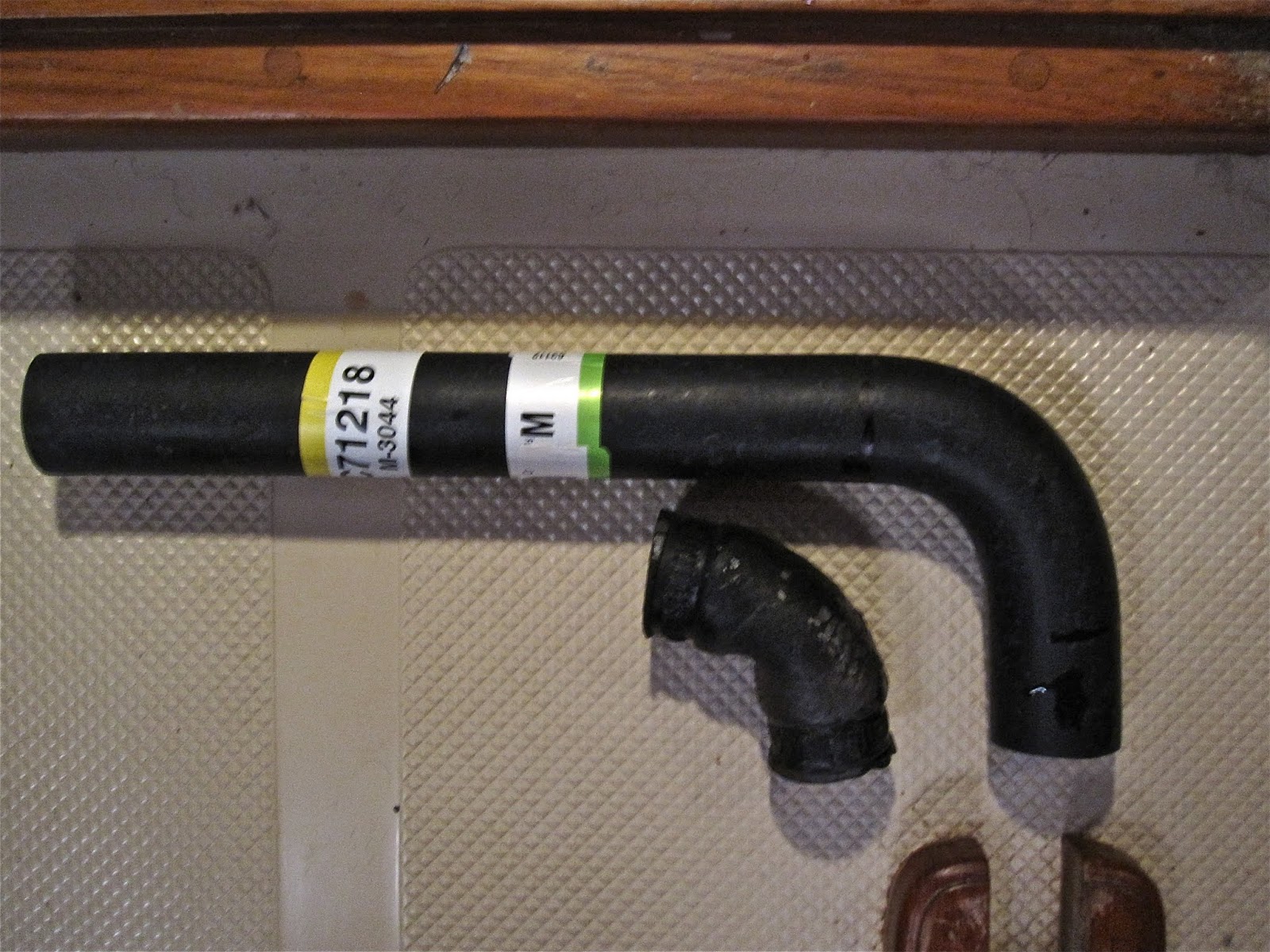
So Monday morning, 0730, we're ready to go. I fire up the engine and go below to do our routine visual check to make sure it's behaving properly. It's not. I notice some coolant in the drip pan and as I look around I notice a fairly rapid drip coming from the hose on the thermostat. When I take a closer look I find the hose is split just past the hose clamp and is leaking down the underside and dripping down to the pan. I'm pretty sure this has been leaking ever since we bought the boat. We've always found fluid in the pan after running the engine but could never find the source of the leak. The only reason I found it this time was because I was looking in from the side at an odd angle and just happened to see the leak at the hose.

Because of the leak rate I felt that we needed to change this baby out before we went anywhere. This was the one hose I didn't change when I replaced the heat exchanger. Figures. I had gotten a replacement for it from Yanmar but the hose they gave me was straight and I needed one with an 80 degree bend. When I tried to put it on it kinked so badly I was concerned about flow restriction so I just put the old one back on. Now I'm paying the price for that decision. So, it's 0730 and the local Yanmar dude doesn't even get in until 0900 on Tuesday, this being a holiday. I know it'll take at least three days to get a hose from the factory and even then it might not be the right one. I decided to wait it out another day and see what he might suggest. My brain works best in subconscious mode and overnight I came up with a better solution. Instead of waiting until 0900 for the Yanmar dude I drove down to the local Auto Zone at 0800 and asked if I could hunt through their pre-formed radiator hoses for one that might work. Found what I needed ($10), took it home and cut out the short bend that I needed to make the repair. It looks like it was made for it. Perfect. Did I mention that the Yanmar hose cost $50?
(Chart of Hudson Creek) By the time we took care of a few other things it was the middle of the afternoon. I figured this was too late to attempt a trip to the Patuxent but we could still make it over to the Little Choptank and then have a short run over to the Patuxent the next day. It's always good to be flexible. So, on the hottest day so far this year, 96 in the shade, and with zero wind we motored across the Bay and anchored behind Casson Point on Hudson Creek. This is a beautiful spot, secluded, well protected with good depth, 10', and good holding for the anchor. We got there around 1930 and after we were settled in I went for a swim. The water was slightly salty and felt like about 85 degrees, a bathtub. About 45 minutes after the sun went down a nice breeze kicked up that kept us comfortable for the rest of the night. After breakfast and a morning swim we took off and headed out towards the Bay for our next destination.
(Chart of Cuckold Creek) We motored out the Little Choptank to G3 behind James Island before setting sail, heading up to G1 and then shooting out westward across the Bay. The wind was out of the south at about 15 knots and we tacked our way down to the Patuxent. We then ran under power past Solomons Island and after passing under the Rte 4 bridge turned into Cuckold Creek on the south side of the river. As soon as we got to R4 we turned to port and entered a beautiful secluded little cove on the north side of Mill Creek. There's no houses on this side of the creek and with no other boats we had the place to ourselves. We anchored in 12' of water with good holding and settled in for the night. I had an evening swim to cool off and took a brush to the waterline of the boat and scrubbed off the scumline that had built up over the winter. We had a cool breeze that kept us comfortable throughout the night. In the morning we headed out with a stiff 20 knot breeze out of the north. After we passed under the Rte 4 bridge we ran under sail, main and staysail, for easy one man handling while Cheri was on a conference call. By the time she got off the phone we were out in the Bay sailing wing and wing on a north breeze and had gotten as far south as the Navy target area.
We continued on past Point No Point but as we approached Point Lookout at the mouth of the Potomac River the wind veered around to the west and cranked up to 30 knots. The river is quite wide here, over seven miles across, and as we turned into it we had to tack back and forth against the wind and what we estimated to be 6' waves, not to mention the natural outward flow. "Mr. Toad's wild ride" pretty much sums it up. In fact, after tacking for over two hours and making no progress at all we finally gave in, fired up the engine and secured the sails. Even then, under power at 2500 rpm's we only made 3 knots at best. We eventually made our way over to the northern shore where the waves weren't so bad and made good progress from there up to St. Mary's River. Check out our videos (click here) and (then click here).
(Chart of St. Marys River) St. Mary's River is probably the prettiest river on the Chesapeake Bay. It winds back through wooded hillsides with occasional views of historic mansions. The oldest estate in Maryland, built in 1644, is located here. Once back into the protected shores of the river the wild winds were reduced to pleasant breezes. We worked our way into St. Inigoes Creek and found a good anchorage back in Church Cove with 13' of water and good holding. Despite being surrounded on all sides by large homes, the cove is large enough that we anchored out in the middle and felt totally secluded. There's probably room in this cove for 20 boats but we were fortunate to share it with only one other for the night we were there. I continued with my morning and evening swims here.

The next morning we decided to explore the rest of the river to see if we could find a more secluded anchorage. We powered our way up the river past historic St. Marys City, the first capital of Maryland, and wound our way upriver to Tippity Wichity Island. On the charts this looked like a really nice spot to anchor for the night plus that island just has a really cool name. Once we got up to the area though, we found the banks to be shorn of trees and lined with houses and farmland. The river really widens out at this spot and I felt that as an anchorage it didn't provide the kind of protection I was looking for. We headed back downriver and Cheri went below to bake cookies and cook up some bacon for use in later meals. As we approached Horseshoe Bend I decided we needed to spend some time ashore in the old city for a chance to stretch our legs. We were the only boat within sight and took advantage of that by pulling up to the College dock where we were assisted by a smiling student. We walked into the reconstructed town, wandered through the graveyard reading old headstones and gave Bella a chance to run loose in the large grassy area by the boathouse. We hiked down to Church Point and wandered around the village too. There's a big herb garden behind one of the houses and the nice lady in the gift shop allowed us to fill a bag with fresh cuttings. The big attraction for me was the Dove, a reproduction of one of the ships that brought the first colonists to this area. This thing is only 10' longer than La Vida Dulce. Back at the dock we rinsed the boat off with fresh water, emptied our trash and continued on our way.
(Chart of Price Cove) St. Marys River offers a number of excellent spots to anchor but we chose to head back out to the mouth of the river to get a quicker start in the morning. We were looking for an anchorage that would be fairly secluded and safe. On the north shore of the river right at the entrance is Saint Georges Creek and just inside that to starboard is Price Cove. The wind was still blowing 25 knots out in the open river and we were really hoping for a nice peaceful spot for the night. Price Cove is tucked back out of the way surrounded by flat grassy areas and occasional stands of tall trees. There isn't much protection from the wind but the water is calm being almost totally enclosed by land and, best of all, there are no houses at all. We anchored way back there by the duck blind and had a good breeze to keep us comfortable and the boat hardly moved at all. Swimming was good here too. This is a really nice anchorage.
The next morning (Saturday, 6/4) we headed out around 0930, early for us. The wind had died down to almost nothing so we ran under power out to the mouth of the Potomac. Here we encountered what's called the Potomac Swim (click here), where a large group of crazy people swim 7.5 miles across the widest part of the river. When we arrived there were swimmers and kayaks and small boats stretched all the way across the Potomac. I spotted a pretty good gap and headed for it. Cheri stood up in the bow and kept watch for potential targets. I got a call on the radio from the Coast Guard and responded to them but another boat stepped on my response so I don't think they got it. All of a sudden this high speed USCG river boat comes flying up beside us. I throttled back and they pulled up right next to us and I'm thinking "whew, got all that safety stuff just in time". They asked if I knew there were swimmers in the water and I pointed out that we had posted a safety watch for that very reason. They were duly impressed and told us to carry on and enjoy our voyage. Nice fellas.
Once past the line of swimmers we headed out to Smith Point Light. It was here that we passed fairly close to the presidential yacht U.S.S. Sequoia (click here). This is a 104' motor yacht built in 1925 and is a historic national landmark. She was used exclusively as a presidential yacht until 1977 when Jimmy Carter had her decommissioned, just one of the many unforgettable things he accomplished during his presidency. Hey, let's give away the Panama Canal! But I digress. This beautiful yacht is available for charter in DC for about a gazillion $/hour and I'm wondering what she was doing way out at Smith Point Light. Didn't look like there were any guests aboard but I did see a tall, skinny, black dude at the wheel. I wonder.....
Because of the length of our trip I'm going to divide this up into several parts. It's taken me forever to get this far on it and there's still another week to go. Look for part II coming soon. I swear.
The installation of the wind generator took much longer than I had anticipated and pushed back the start of our vacation from Friday, 5/27 (which was really wishful thinking anyway) to Sunday, 5/29. Then we started thinking about all the crazy boaters out on the Bay over Memorial Day Weekend and decided it'd be smarter to leave on Monday when everyone else would be heading home. By the time we'd get to Cuckold Creek on the Patuxent River we'd have the whole place to ourselves. Good plan.
So Monday morning, 0730, we're ready to go. I fire up the engine and go below to do our routine visual check to make sure it's behaving properly. It's not. I notice some coolant in the drip pan and as I look around I notice a fairly rapid drip coming from the hose on the thermostat. When I take a closer look I find the hose is split just past the hose clamp and is leaking down the underside and dripping down to the pan. I'm pretty sure this has been leaking ever since we bought the boat. We've always found fluid in the pan after running the engine but could never find the source of the leak. The only reason I found it this time was because I was looking in from the side at an odd angle and just happened to see the leak at the hose.
(Chart of Hudson Creek) By the time we took care of a few other things it was the middle of the afternoon. I figured this was too late to attempt a trip to the Patuxent but we could still make it over to the Little Choptank and then have a short run over to the Patuxent the next day. It's always good to be flexible. So, on the hottest day so far this year, 96 in the shade, and with zero wind we motored across the Bay and anchored behind Casson Point on Hudson Creek. This is a beautiful spot, secluded, well protected with good depth, 10', and good holding for the anchor. We got there around 1930 and after we were settled in I went for a swim. The water was slightly salty and felt like about 85 degrees, a bathtub. About 45 minutes after the sun went down a nice breeze kicked up that kept us comfortable for the rest of the night. After breakfast and a morning swim we took off and headed out towards the Bay for our next destination.
(Chart of Cuckold Creek) We motored out the Little Choptank to G3 behind James Island before setting sail, heading up to G1 and then shooting out westward across the Bay. The wind was out of the south at about 15 knots and we tacked our way down to the Patuxent. We then ran under power past Solomons Island and after passing under the Rte 4 bridge turned into Cuckold Creek on the south side of the river. As soon as we got to R4 we turned to port and entered a beautiful secluded little cove on the north side of Mill Creek. There's no houses on this side of the creek and with no other boats we had the place to ourselves. We anchored in 12' of water with good holding and settled in for the night. I had an evening swim to cool off and took a brush to the waterline of the boat and scrubbed off the scumline that had built up over the winter. We had a cool breeze that kept us comfortable throughout the night. In the morning we headed out with a stiff 20 knot breeze out of the north. After we passed under the Rte 4 bridge we ran under sail, main and staysail, for easy one man handling while Cheri was on a conference call. By the time she got off the phone we were out in the Bay sailing wing and wing on a north breeze and had gotten as far south as the Navy target area.
We continued on past Point No Point but as we approached Point Lookout at the mouth of the Potomac River the wind veered around to the west and cranked up to 30 knots. The river is quite wide here, over seven miles across, and as we turned into it we had to tack back and forth against the wind and what we estimated to be 6' waves, not to mention the natural outward flow. "Mr. Toad's wild ride" pretty much sums it up. In fact, after tacking for over two hours and making no progress at all we finally gave in, fired up the engine and secured the sails. Even then, under power at 2500 rpm's we only made 3 knots at best. We eventually made our way over to the northern shore where the waves weren't so bad and made good progress from there up to St. Mary's River. Check out our videos (click here) and (then click here).
(Chart of St. Marys River) St. Mary's River is probably the prettiest river on the Chesapeake Bay. It winds back through wooded hillsides with occasional views of historic mansions. The oldest estate in Maryland, built in 1644, is located here. Once back into the protected shores of the river the wild winds were reduced to pleasant breezes. We worked our way into St. Inigoes Creek and found a good anchorage back in Church Cove with 13' of water and good holding. Despite being surrounded on all sides by large homes, the cove is large enough that we anchored out in the middle and felt totally secluded. There's probably room in this cove for 20 boats but we were fortunate to share it with only one other for the night we were there. I continued with my morning and evening swims here.
(Chart of Price Cove) St. Marys River offers a number of excellent spots to anchor but we chose to head back out to the mouth of the river to get a quicker start in the morning. We were looking for an anchorage that would be fairly secluded and safe. On the north shore of the river right at the entrance is Saint Georges Creek and just inside that to starboard is Price Cove. The wind was still blowing 25 knots out in the open river and we were really hoping for a nice peaceful spot for the night. Price Cove is tucked back out of the way surrounded by flat grassy areas and occasional stands of tall trees. There isn't much protection from the wind but the water is calm being almost totally enclosed by land and, best of all, there are no houses at all. We anchored way back there by the duck blind and had a good breeze to keep us comfortable and the boat hardly moved at all. Swimming was good here too. This is a really nice anchorage.
The next morning (Saturday, 6/4) we headed out around 0930, early for us. The wind had died down to almost nothing so we ran under power out to the mouth of the Potomac. Here we encountered what's called the Potomac Swim (click here), where a large group of crazy people swim 7.5 miles across the widest part of the river. When we arrived there were swimmers and kayaks and small boats stretched all the way across the Potomac. I spotted a pretty good gap and headed for it. Cheri stood up in the bow and kept watch for potential targets. I got a call on the radio from the Coast Guard and responded to them but another boat stepped on my response so I don't think they got it. All of a sudden this high speed USCG river boat comes flying up beside us. I throttled back and they pulled up right next to us and I'm thinking "whew, got all that safety stuff just in time". They asked if I knew there were swimmers in the water and I pointed out that we had posted a safety watch for that very reason. They were duly impressed and told us to carry on and enjoy our voyage. Nice fellas.
Once past the line of swimmers we headed out to Smith Point Light. It was here that we passed fairly close to the presidential yacht U.S.S. Sequoia (click here). This is a 104' motor yacht built in 1925 and is a historic national landmark. She was used exclusively as a presidential yacht until 1977 when Jimmy Carter had her decommissioned, just one of the many unforgettable things he accomplished during his presidency. Hey, let's give away the Panama Canal! But I digress. This beautiful yacht is available for charter in DC for about a gazillion $/hour and I'm wondering what she was doing way out at Smith Point Light. Didn't look like there were any guests aboard but I did see a tall, skinny, black dude at the wheel. I wonder.....
Because of the length of our trip I'm going to divide this up into several parts. It's taken me forever to get this far on it and there's still another week to go. Look for part II coming soon. I swear.
Monday, May 16, 2011
Lucky Strikes
This past weekend, 5-13, we went sailing. I mean all weekend. On Friday (the 13th!!!) we had our good friends, Anthony and Luzma, join us for a day-sail. They showed up around 1130 with dishes of Peruvian food that Luzma had put together so we sat down for an early dinner. We hadn't seen these guys since last October so there was a lot of catching up to do. Around 1400 we cast off and headed out across the Bay, getting as far as R84A at the mouth of Eastern Bay. The wind was out of the SE at 15 to 20 kts, beautiful day. Anthony manned the helm for most of the way and we returned home by 1900. Good company, easy chit-chat, nice day for a sail.
The next day, Saturday, started out with heavy overcast skies and temps in the 60's. Cheri's nephew, Brian, and his wife, Katie, and their two year old daughter Kaitlyn joined us for a two day sail up to Osprey Point Marina in Rock Hall and back again. There's a really nice B+B there as well as a 5 star restaurant. Brian's parents had reserved a room for them at the B+B to celebrate their three year anniversary and we had volunteered to take care of Kaitlyn on the boat. Yikes!
We got the boat loaded up and headed out around 1100 in the middle of a torrential downpour with lightning flashing overhead. We had reservations for dinner at 1900 so we didn't really have time to wait it out. The rain continued until we cleared G83A just outside of Herring Bay. The sail up to Rock Hall took all of 7 hours with light winds out of the SE for most of the trip. We pulled into Osprey Point Marina at 1810 with little time to spare in getting ready for dinner. Cheri pushed our reservations back to 1945 so we'd all have a chance to get settled in.
Dinner was fantastic, a true gourmet delight. We checked out the kids' room before turning in for the night. They had two rooms overlooking the marina, a closet and a flushing toilet. Pretty swank! Back at the boat the three of us sat up and watched Finding Nemo. For the rest of the weekend Kaitlyn was searching the Bay for Nemo. The next morning, after a quick breakfast we headed out for the return trip to HHN. Winds were 15 kts out of the SSE which gave us a challenge all the way home, requiring tacking all the way down the Bay. The voyage started with our departure from Osprey Point. Motoring out of Swan Creek I misread the channel markers and turned at the wrong place and ran aground. Hitting the side of the dredged channel was like running into a brick wall, almost knocked Cheri overboard. I backed down hard, dragged the keel out of the mud and continued down the creek like nothing had ever happened. We ran down to GC#3 (green can #3) under power because the wind was right on our nose. Once we turned out into the Bay we unfurled the sails and cruised out in light but steady winds at 5 to 6 knots. Unable to pass straight under the Bay Bridge because the wind was blowing from directly behind it we began a series of tacking maneuvers that would last throughout most of the day. We tacked four times approaching the Bay Bridge and probably six more times just trying to get down to Thomas Point Light. Grrr. Every time I tried to overcompensate to get us additional room to maneuver the wind would shift just enough to throw everything off and we'd end up having to tack again to clear an obstacle. There were about six tankers parked out in the mooring field outside of Annapolis and on our final tack around Thomas Point we were interrupted by four loud blasts from behind us. One of the tankers was getting underway and we were directly in front of him. We made a quick turn to port and circled around behind him before continuing on our way.
At this point the wind was still coming directly out of where we wanted to go and a quick glance at my watch revealed that we had wasted the better part of the day tacking all over the place. It was 1700 and we were still about three hours from home as the crow flies. We fired up the engine and headed for Herring Bay at 7 kts. The weather was perfect, mid 70's, clear skies, and we had removed part of the cockpit enclosure to get some fresh air blowing through. As the day wore on everyone stretched out and took a nap. Well, everyone but the guy at the helm.
After we passed West River the wind shifted around to the SE and we were able to break out the sails and shut off the engine. The wind picked up to about 25 kts and we were having a great sail home, heeled over and crashing into the waves. That's what I'm talkin' about! This was when I noticed a really humongous cumulonimbus cloud building up to the south of us and some pretty dark grey, almost blue/black, areas directly below it. I woke everyone up and suggested we get the enclosure back in place because it looked like we might get some rain. We were able to sail for about an hour more before finally giving in to the need to get home quickly and once again fired up the engine and put the sails away. At this point it was about 1915. We were still over an hour from our slip, it was getting pretty late, and the kids had a 90 minute drive home once we got in.
We'd gotten about halfway across Herring Bay when some fairly large rain drops began to pelt the boat. We were headed straight for Herrington Harbour South which we always do when coming in because they have a really huge white tent set up in the marina that you can see from a hundred miles away. Now though, as I watched that tent it disappeared behind a wall of rain. Not two minutes later we were blasted by this tremendous force of wind that came screaming through the bare rigging and spun the boat 90 degrees in a matter of seconds. There were bolts of lightning hitting all around us (I saw four strike the water) and I couldn't help but think about that 59' tall aluminum mast sticking up in front of us. I suggested to Cheri that she might get the fire extinguishers out, make 'em handy just in case. By now the rain was coming down so hard we couldn't see anything beyond the boat and the wind was still howling. The last thing I saw before the rain hit was the #1 marker out at the entrance to the Bay so I knew vaguely where we were. I didn't want to drift in too close to shore and we had shallow water on three sides of us so I eyeballed the compass and steered around for 090 to get us headed towards that #1 marker and deeper water. I kept the engine at 2000 rpm's which was enough to make some headway against the wind and felt like we'd be OK as long as we didn't get hit by lightning. Said my prayers for help with that.
After a few minutes (seemed like an eternity) the rain slackened and the wind died down. The sun peaked out from under the clouds just as it began to settle down behind the trees on the western shore. To the south of us was another wall of rain approaching so I decided to take the break in weather and head for home. I set our course for R2 where we make our turn for Herrington Harbour North. As the rain started up again I asked Brian and Cheri to search ahead for the channel marker. Brian was the first to see it and pointed the way home. We motored home on a compass course and passed through the harbor entrance just as the marker lights came on. It was pretty near dark by the time we got into the slip.
The whole weekend was really great. We visited with some friends we hadn't seen in a while. We really enjoyed our time with Brian and Katie. We got to play with Kaitlyn. I think what'll really mark this trip though is that incredible storm at the end of the day. Wow!
The next day, Saturday, started out with heavy overcast skies and temps in the 60's. Cheri's nephew, Brian, and his wife, Katie, and their two year old daughter Kaitlyn joined us for a two day sail up to Osprey Point Marina in Rock Hall and back again. There's a really nice B+B there as well as a 5 star restaurant. Brian's parents had reserved a room for them at the B+B to celebrate their three year anniversary and we had volunteered to take care of Kaitlyn on the boat. Yikes!
We got the boat loaded up and headed out around 1100 in the middle of a torrential downpour with lightning flashing overhead. We had reservations for dinner at 1900 so we didn't really have time to wait it out. The rain continued until we cleared G83A just outside of Herring Bay. The sail up to Rock Hall took all of 7 hours with light winds out of the SE for most of the trip. We pulled into Osprey Point Marina at 1810 with little time to spare in getting ready for dinner. Cheri pushed our reservations back to 1945 so we'd all have a chance to get settled in.
Dinner was fantastic, a true gourmet delight. We checked out the kids' room before turning in for the night. They had two rooms overlooking the marina, a closet and a flushing toilet. Pretty swank! Back at the boat the three of us sat up and watched Finding Nemo. For the rest of the weekend Kaitlyn was searching the Bay for Nemo. The next morning, after a quick breakfast we headed out for the return trip to HHN. Winds were 15 kts out of the SSE which gave us a challenge all the way home, requiring tacking all the way down the Bay. The voyage started with our departure from Osprey Point. Motoring out of Swan Creek I misread the channel markers and turned at the wrong place and ran aground. Hitting the side of the dredged channel was like running into a brick wall, almost knocked Cheri overboard. I backed down hard, dragged the keel out of the mud and continued down the creek like nothing had ever happened. We ran down to GC#3 (green can #3) under power because the wind was right on our nose. Once we turned out into the Bay we unfurled the sails and cruised out in light but steady winds at 5 to 6 knots. Unable to pass straight under the Bay Bridge because the wind was blowing from directly behind it we began a series of tacking maneuvers that would last throughout most of the day. We tacked four times approaching the Bay Bridge and probably six more times just trying to get down to Thomas Point Light. Grrr. Every time I tried to overcompensate to get us additional room to maneuver the wind would shift just enough to throw everything off and we'd end up having to tack again to clear an obstacle. There were about six tankers parked out in the mooring field outside of Annapolis and on our final tack around Thomas Point we were interrupted by four loud blasts from behind us. One of the tankers was getting underway and we were directly in front of him. We made a quick turn to port and circled around behind him before continuing on our way.
At this point the wind was still coming directly out of where we wanted to go and a quick glance at my watch revealed that we had wasted the better part of the day tacking all over the place. It was 1700 and we were still about three hours from home as the crow flies. We fired up the engine and headed for Herring Bay at 7 kts. The weather was perfect, mid 70's, clear skies, and we had removed part of the cockpit enclosure to get some fresh air blowing through. As the day wore on everyone stretched out and took a nap. Well, everyone but the guy at the helm.
After we passed West River the wind shifted around to the SE and we were able to break out the sails and shut off the engine. The wind picked up to about 25 kts and we were having a great sail home, heeled over and crashing into the waves. That's what I'm talkin' about! This was when I noticed a really humongous cumulonimbus cloud building up to the south of us and some pretty dark grey, almost blue/black, areas directly below it. I woke everyone up and suggested we get the enclosure back in place because it looked like we might get some rain. We were able to sail for about an hour more before finally giving in to the need to get home quickly and once again fired up the engine and put the sails away. At this point it was about 1915. We were still over an hour from our slip, it was getting pretty late, and the kids had a 90 minute drive home once we got in.
We'd gotten about halfway across Herring Bay when some fairly large rain drops began to pelt the boat. We were headed straight for Herrington Harbour South which we always do when coming in because they have a really huge white tent set up in the marina that you can see from a hundred miles away. Now though, as I watched that tent it disappeared behind a wall of rain. Not two minutes later we were blasted by this tremendous force of wind that came screaming through the bare rigging and spun the boat 90 degrees in a matter of seconds. There were bolts of lightning hitting all around us (I saw four strike the water) and I couldn't help but think about that 59' tall aluminum mast sticking up in front of us. I suggested to Cheri that she might get the fire extinguishers out, make 'em handy just in case. By now the rain was coming down so hard we couldn't see anything beyond the boat and the wind was still howling. The last thing I saw before the rain hit was the #1 marker out at the entrance to the Bay so I knew vaguely where we were. I didn't want to drift in too close to shore and we had shallow water on three sides of us so I eyeballed the compass and steered around for 090 to get us headed towards that #1 marker and deeper water. I kept the engine at 2000 rpm's which was enough to make some headway against the wind and felt like we'd be OK as long as we didn't get hit by lightning. Said my prayers for help with that.
After a few minutes (seemed like an eternity) the rain slackened and the wind died down. The sun peaked out from under the clouds just as it began to settle down behind the trees on the western shore. To the south of us was another wall of rain approaching so I decided to take the break in weather and head for home. I set our course for R2 where we make our turn for Herrington Harbour North. As the rain started up again I asked Brian and Cheri to search ahead for the channel marker. Brian was the first to see it and pointed the way home. We motored home on a compass course and passed through the harbor entrance just as the marker lights came on. It was pretty near dark by the time we got into the slip.
The whole weekend was really great. We visited with some friends we hadn't seen in a while. We really enjoyed our time with Brian and Katie. We got to play with Kaitlyn. I think what'll really mark this trip though is that incredible storm at the end of the day. Wow!
Subscribe to:
Posts (Atom)