Wednesday, July 10, 2013

Gearing Up for Going Out


This past winter we concentrated on gear we thought we should have for our Bermuda adventure including safety items, necessary toys and things on our "electronics" list.

We added an auto pilot system which was absolutely essential considering we only had a crew of two.  Having to drive the boat manually for 5 days straight, shared between two people would have been dangerously exhausting.  We also added AIS (Automatic Identification System) which turned out to be very useful, especially at night.  The module has to be programmed by the company you buy it from, in our case MTS.  They put in information about La Vida Dulce including the boat's name, LOA (length), Beam (width), Draft (depth), location of AIS antennas on board, MMSI #, USCG documentation # and our boat's call sign.  All this stuff gets broadcasted along with our GPS location so other ships can see where we are and contact us if necessary.  From their display they'll be able to tell who we are, where we are and what direction and speed we're going.  We'll also get this same information about them.  On more than one occasion this turned out to be very useful and we were able to contact large ships that were on a converging course with us and verify that they were aware of our presence.  AIS in conjunction with radar made sailing at night do-able.  Another thing that got a lot of use was a remote microphone with full controls for the VHF radio.  The radio is mounted below at the Nav station and having this mic mounted at the helm made life easier and safer.  We had used a hand-held VHF radio before but it's range was very limited, just a few miles at the most.  Our main radio has up to 25 watts of power and it's antenna is mounted at the top of our 59' mast.  We routinely made contact with other ships over 15 miles away.

One of our big concerns was getting a life raft for the trip.  We looked into buying one but there are a few things that held us back.  A life raft for off shore is built to higher standards than one for coastal or inland waters.  The floor is insulated, the material it's built from is more rugged, it has a canopy and a whole list of additional stuff to keep you alive in harsher conditions.  This is all good but it comes at a hefty cost.  We wanted a six man raft and the price for that is over $4000.  On top of that they're required to be sent back to the factory every one to three years to be inspected.  If we bought one now it'd have to be sent in shortly after we leave in 2014.  Another option for us was to rent one for this trip.  We looked around and all the ones we saw were about $65/day.  That comes to around $1365 for this trip alone.  Yikes!  That's a pretty good chunk of change and would go a long way towards ownership.  Tough call.  Then we got a note from one of the other guys going on the trip with us and he found a rental place in Norfolk that gave us a six man raft for $550.  I jumped on that!  The one we rented was in a satchel and we stored it in the cockpit locker.  We kept it loose in there thinking we wanted to be able to get it out in a hurry.  This turned out to be a bad idea because that satchel weighed about 90 pounds and during that storm on the return trip it really got knocked around, tearing loose both the depth sounder module and the diesel heater.  When we invest in our own life raft I think we'll get one in a canister and mount it somewhere up on deck.

We invested in an EPIRB.  This is a cool little device that when activated sends out a radio beacon that interfaces with the international search and rescue satellite system.  The idea is to get responders going within the first 24 hours of a disaster, the time period of highest survivability.    Our EPIRB is manually activated, which means we have to unclip it from it's mounting bracket.  Once unclipped it automatically begins sending out it's signal.  There is another type that begins when immersed in water.  I guess that's good if you forget to unclip it or something.  Maybe one less thing to think about.  Personally I think I'm gonna be concentrating on that little EPIRB if our boat is going down.  I'd probably rip it right off the wall.

Other safety items we added were personal harnesses/lifevests with tethers and jack lines.  Jack lines on our boat are attached just aft of the bowsprit at deck level and run along both sides on the cabin top.  They terminate at padeyes mounted on the outside of the cockpit coaming.  There's another pair of jack lines in the foot well of the cockpit.  The idea is that you wear a harness at all times when topside while underway.  The harness is attached to the jack line by a tether that's either 3' or 6' long.  If you need to go forward from the cockpit you stay clipped in at the cockpit until you're clipped onto the jack line going forward.  On some boats the jack lines run along the deck on each side.  We chose to run ours along the cabin top to keep the tether point in closer to the center of the boat in case someone fell, hopefully preventing them from going overboard.  Our harnesses are also our life vests and will automatically inflate when submerged more than 4". We were faithful about using this gear and not taking any chances.  The harnesses were kinda hot though so in mild weather during the day we didn't wear them in the cockpit.  We did stick to our rule about wearing them at night and for going up on deck at any time.  We had two instances in particular when the harnesses paid for themselves.  The first time was when the mainsail blew out.  Jeff and I were on deck in pretty nasty weather getting the main wrapped up and secured to the boom.  Waves were breaking over the bow and more than once I was up to my knees in water.  The second time was on the trip home from Bermuda.  Cheri went up on deck during a squall with 45 knot winds to untangle the out-haul for the staysail.  Only with good harnesses, tethers and jack lines would we have even considered going out there in that kind of stuff.

We had intended to get a single side band radio (SSB) which is a high frequency radio capable of communicating around the world and is also able to send and receive e-mail messages which is very handy for getting up-to-date weather information.  Our cash reserves dried up before we got that far though so we fell back to plan B and rented a satellite phone.  It seemed like a good idea as an alternative to the radio but in actuality we had a terrible time getting a signal and were only able to make one call the entire time we were out.  Before we head out in 2014 we're getting an SSB.


One other thing we did to prepare for our trip to Bermuda was finding a place to stash our dinghy.  Up until now we've been storing it in the dinghy rack at the marina when not in use or pulling it behind the boat when going out to anchor somewhere.  That has worked fine for on the Chesapeake Bay.  Out on the ocean though it's a whole different can of worms.  You don't want to tow it because it'll slow you down a bit which can really add up to extra time on an extended cruise.  More importantly, in rough weather the dinghy can break free and be lost or damaged.  Many boats have davits but for ocean passages you don't really want to have the dinghy hanging off the back of your boat either.  There's a danger of following seas, large waves, breaking over the stern and causing damage to the dinghy and your boat.  The safest place to stow it is up on deck.  Our dinghy is an inflatable with a hard, fiberglass bottom, is over 10' in length and weighs more than 80 pounds.  Not something you're gonna just yank out of the water and toss up on deck.  I could use the mainsail boom as a type of crane but it's tethered by the mainsheet and a bunch of other lines and would be limited in height and swing.  I've been mulling this over for a while and came up with something that would work better for me.  I picked up an old spinnaker pole at a yard sale.  It's only 14' long but is plenty stout at 3" in diameter.  I put together a 6:1 block and tackle with 75' of 7/16"double braid line.  I also had Atlantic Spars and Rigging build me a double D fitting that looks like a fat figure eight, made of 3/8" stainless steel rod (see the middle picture).  This fitting goes in one end of the spinnaker pole and our spare main halyard attaches to the top of it.  From the bottom hangs the block and tackle attached to a harness holding the dinghy.  The other end of the pole mounts on the mast just to one side of the boom.  I now have a fully functioning derrick that extends out far enough over the side of the boat to easily hoist the dinghy using a three point harness.  It's very handy to be able to hang the dinghy off the side of the boat several feet off the water to allow it to dry before stowing it away.  This also is a good way to prevent algae growth on the bottom of the dinghy when it's not in use.  To stow it we haul it up over the lifeline and set it on the cabin top just under the main boom.  I've set up two four foot 4x4's to act as a cradle to keep it off the deck and allow airflow underneath.  These are only temporary though and I plan to eventually make something that's permanently mounted and sits a few inches higher.  Our dinghy deflates and folds in on itself to just the size of the fiberglass pan and neatly stows inside the zip-top bag it was delivered in when we bought it.  There are a few things we need to add at the mast to make everything work smoothly.  We need a line clutch for the primary main halyard to free up the one winch on the starboard side of the mast.  We also need two 6" cleats to tie off the two control lines; the line from the block and the secondary main halyard that hoists the pole.  For now these lines get tied off to the mast pulpit, the safety railing on either side of the mast.  When not in use we store the pole on the lifeline stanchions using Forespar spinnaker pole mounts.  The first time I used this system for launching the dinghy it was kinda cumbersome because I had to figure everything out as I went along.  The second time it went much smoother and really showed it's value.  Once we have everything in place I think this will be a really nice addition to the boat.  It provides a good safe spot for storing the dinghy and doesn't block the view at all when you're seated at the helm.  It's fairly simple to launch and recover, even with just one person doing the work.  It also gives us a second use for the pole as an inexpensive whisker pole for the genoa, something I've been wanting for some time now.  Two birds, one stone.

Tuesday, July 9, 2013

So Much Stuff!!!


When we sold our house and moved on board we were able to sell pretty much everything we had in a short time.  Nevertheless, we still had a pile of stuff we just couldn't let go of.  There were the expected things, stuff we wanted to hand down to our kids, family heirlooms.  But there were also quite a few "things" that we just couldn't let go of yet.  A large portion of this was Cheri's kitchen stuff.  She had assembled a copious collection of tools and gadgets for her gourmet kitchen.  Breadmakers (2), pizzelle maker, waffle maker, rice steamer, slow cooker, pots and pans of all sizes, apple peeler, hand held and countertop mixers and just a ton of utensils, bowls, dishes, etc.  She also had several sets of really nice dishes and a beautiful collection of antique tea cups and tea pots.  And plenty more.

Cheri is also an artist and has quite a collection of oil and water color paints, easels, paper and canvasses, brushes and books.  Oh, did I mention she also like to sew and make quilts.  For this she has three sewing machines, hundreds of spools of thread and a collection of material that had been organized by color and stored on floor-to-ceiling shelves on an 18' long wall.  Oh yeah, she's also a musician and was playing piano when we bought the boat.  She down-sized that to an 88 key electric keyboard and we tried having that on board for the first year or so.

We're both into photography and have a pretty good collection of cameras, lenses, filters, tripods, bags and flashes.  At least we're doing digital now.  That's a big savings in storage space.  I'm also into model railroading and have a collection of kits that I plan to build after I retire.  With that goes paints, brushes, tools, modeling vise, chalks for weathering and more.  I'm planning to build one kit at a time as small dioramas and ship them back home to storage.  Once we've sailed around until we can't stand it anymore I hope to build a model railroad and incorporate all my dioramas into it.  This plan is probably not very realistic but I'll give it a try for a while and see how it goes.  Another hobby I had until recently was working on cars and motorcycles.  This hobby is kinda tough to do while living on a boat so I've given that up.  Not exactly a hobby but I do most of the work on the boat myself so I also have a pretty good collection of hand and power tools.  Oh, yeah, I'm also learning to play the guitar.  Besides all that we also have extra clothes for work and off-season.

All this is to show that we still have a pretty good pile of junk that either needs to be reduced or find it's way onto the boat.  The heirlooms and hand-me-downs were in storage in Florida but had to be relocated back up here recently so now we have two temperature controlled storage compartments in Annapolis and a small shed at the marina for boat stuff.  We've decided to give now those things that would have been left to family in our wills later on.  That kinda kills the party when we pass away but so it goes.  After being on the boat for three years we are beginning to see what gets used and what doesn't, what we really need.  There's a lot of stuff in storage that could realistically just go away and we'd never miss it.

The past two weekends we've been sorting through our storage units and reducing the stuff.  We've now got it down to just one unit and with a little more work we could actually get a smaller one.  Last weekend we finished up early on Saturday afternoon and decided to sail somewhere and anchor out.

We didn't get away from the dock until 1600 so our options were kinda limited.  With the wind coming out of the SE at 15 knots they were reduced even more and our only realistic choice was going to the Rhode River, about 2 or 3 hours away to the North.  We'd never been to the Rhode before but had heard it was very nice and fairly secluded.  We ran before the wind on a broad reach and made about 6 knots before finally turning into the West River.  It was getting on to 1900 at this point so we packed the sails away, rolled 'em up, and motored the rest of the way into the Rhode River.  This is indeed a pretty spot.  The shore is lined with tall trees and heavy vegetation.  There are houses but they seemed more set back into the trees and were less obtrusive here.  Our chart showed two islands toward the end of the deep water and I planned to find a protected anchorage behind one of them.  As we made the last turn in the river we found a large community of boats already anchored.  I quickly spotted one of the islands but the other, the bigger of the two, was not where it showed on the chart plotter.  I began to doubt my GPS as we slowly motored in and as the display showed us driving up on it's shore I quickly turned around.  We still showed 10' of water under us but I could not make sense of what I saw.  Or didn't see.  We passed a small marker that had the word "shoal" printed on it and I spotted another further back.  Cheri called up a GPS app on her iPad and said the island, High Island, was marked as "submerged".  Woulda been nice if my chart software had mentioned that.  We motored over by a large group of anchored boats, dropped our anchor in an open area and let out 60' of chain.  The anchor held and we settled down in the cockpit with our Bloody Mary's to enjoy the evening.  After sitting there for about 20 minutes I realized we had anchored and drifted back very close to that "shoal" line.  I also noticed lapping waves about 10' off our stern.  We still showed 10' of water but we were very close to the top of that submerged island and the waves were breaking over the top of it.  Ten feet away.  We put down our Bloody Mary's and relocated the boat to another spot, further away from the crowd and also further away from the submerged island.  We enjoyed a quiet night after that.

The next morning we slept in late and finally rolled out around 0930.  The first thing we found was that it was raining.  Yesterday's prediction had said 20% chance of rain.  Nice job guys.  We had all our hatches open and things were soaked.  After drying and cleaning up the mess we looked around the anchorage and realized the crowd was gone and we were one of two boats left.  This is more like it!  We had coffee and scones and sat around and enjoyed the rest of the morning.  We finally took off around 1430 and headed home in between 20% thunderstorms.

All in all I'd say the Rhode River is an OK spot for an over-nighter.  It's close to HHN so it works especially nice if we're making last minute plans.  It is a pretty popular spot though, fairly crowded, and not exactly my number one choice for a good get-away kinda spot.  It also has this huge underwater island that's not properly marked on the charts.  Local or previous knowledge pays off here.  And I guess sometimes ya just gotta really pay attention to where you're going.  This boating stuff is not as easy as it looks!

Wednesday, June 19, 2013

Bermuda Run, Part 3


Our stay in Bermuda was really great, relaxing, totally enjoyable.  We walked practically everywhere.  People in Bermuda apparently don't walk around though.  They have this really great public transportation system that includes buses and ferries.  You can get a pass at the Post Office and travel anywhere on the island for one price.  We got a three day pass and I think we paid $35 for both of us.  You get a card full of passes and just tear one off each time you board the bus or ferry.  Scooters also seem to be a major form of transportation there.  Only tourists and the poorest locals actually walk to get around.  There are no sidewalks in St. George Parish and most property is lined with walls that go right out to the street.  When you walk you're in the road and passing traffic doesn't swerve out to go around you.  You are in their way.  Not only that but they drive on the wrong side of the road so you have to keep that in mind when you walk along those narrow, curvy, hilly roads.  Of course the people are so damned nice there if they actually ran you over they'd probably smile and laugh and be very friendly about it.

While we were there we walked into town to do our laundry.  We had three large sacks and it was a pretty good hike to the laundry-mat but we heard that they would do it for you for a pretty reasonable price.  We figured we could drop it off, wander around town for a few hours and pick it up on the way back to the marina.  Good plan.  Unfortunately there was no one there.  The sign on the wall said to call this number for the service so we did that.  The lady who answered said she had just left and didn't feel like coming back so we could do it ourselves.  OK.  That's pretty laid back service.  The only problem was that the machines all ran on time cards, not coins.  You had to buy a card for $5 (Bermuda cash only) and then put more money on it to buy time on the washers and dryers.  I had to hike into town to get some local dinero at the bank.  We got the washers going and walked back into town for lunch before returning to finish our three loads of laundry.  Total cost for the wash and dry was $30.  Yikes!

After we finished our laundry we bundled it up and left it in a corner.  We decided to take a hike up the hill to see some sights.  At the top of the hill is a church that was built in the late 1800's.  It was going to be pretty big, large enough to seat 650.  Unfortunately the church was never completed.  There was apparently some infighting between the parishioners and they split off and formed another church while it was still under construction.  Then the day before it was to be completed the steeple was struck by lightning.  This was considered to be some bad ju-ju and the church was left unfinished.  I'm not kidding.  It sits there on top of a hill overlooking the harbor, probably one of the best sites on the island.  Completely unused for over a hundred years.  It's located off of Church Folly Road.  Go figure.

We walked from there over the hill to get a view of one of the many forts on the island.  It's located next to a beautiful beach but when we got over the hill we decided it was too late in the day for a swim so we just continued hiking around.  We followed a path through an open gate and found the ruins of some colossal structure.  It had tunnels and underground rooms, stairs leading all over the place and one gigantic room that was as big as a football field.  We climbed all over this place but couldn't figure out what it had been.  When we returned to the marina one of the guys from Starshine said it had been a Club Med resort back in the 1960's.  It had been so poorly constructed that they eventually had to tear the building down and it's been sitting like that for thirty years now.  Wow!  This was a real day for follies!

Back at the boat we talked with Bob about when would be a good time to head home.  Never was my first thought.  We didn't get there until Tuesday the 4th and it was now only Thursday the 6th.  Bob wanted to leave the next day, Friday, because he had a conference scheduled for the next week.  We didn't have to be back at work until Monday, June 17th so I was thinking we could hang out until Monday or Tuesday, June 10th or 11th.  The thing is, you really need to take weather into account for that five day sail home.  Our weather routers said that leaving on Friday was a really bad idea because there was a Tropical Storm working it's way up the US coast.  Leaving that weekend was also not good because right behind that storm was a cold front coming in from the West that would make for really bad conditions on the Gulf Stream.  They recommended that we stay another week in Bermuda.  Uhm, that might not work for us.

Bob decided to leave Saturday afternoon and take a course that would keep them South of any bad weather and they'd have the option of ducking into the Intra-Coastal Waterway, ICW, and heading North from there.  We thought we might stay until Monday or Tuesday and get an update on the weather, hoping for better conditions.

Saturday afternoon, after saying our goodbyes to the Starshine crew, Cheri and I went to a formal tea at a perfume factory in St. George.  Beautiful old building, nice grounds.  The tea was outside in the rose garden and we had a very nice time.  Tea is something that Cheri is really into so this was a special event for her.  We also did some final gift shopping in town before heading back to the marina around 1630.  When we got to the boat we saw Starshine heading out of the harbor.  I decided to grab my iPad and head up to the bar to see if I could get an internet connection and an update on the weather.  When I got connected the forecast did not look good.  The following Thursday and Friday there was supposed to be some really bad weather, high winds and rain, and the rest of the weekend was not good either.  Our weather window was closing and it looked like we might be stranded in Bermuda for at least another week.  And this was the beginning of Hurricane season.  I decided on the spot that Bob had probably made the best decision and that we should head out as soon as possible.  We were on our way in two hours, about four hours behind Starshine.

I really wanted to beat the storm that was forecast for Thursday afternoon on the Chesapeake Bay.  It was supposed to be huge, another derecho.  On the weather maps it covered all of the Chesapeake Bay and most of it was dark purple, severe.  I calculated that if we averaged 6.5 knots for the entire voyage, 640 miles, we'd make it back before the storm hit.  OK, I think we can do that.  We could motor-sail to keep our speed up but we only had a little over half a tank of fuel, approximately 100 gallons, and the local fuel dock was now closed.  If we were conservative though, I was pretty sure we could make it.  No problem.

We officially checked out through Customs at 1930 and were on our way.  We had perfect sailing weather with 15 knot winds from the SE and we skirted the reef on the N side of the island and chose a course that would take us towards North Carolina to pick up the Gulf Stream.  We had gotten waypoints from Dane, the weather router, and had them programmed into our chartplotter.  Once outside the reef we tried calling Starshine on our VHF radio.  Around 2300 we picked up a very weak signal but managed to hear that they had chosen to bypass the first waypoint and were currently making about 6 knots.  We were making about 6.5 to 7 and I figured we could catch up to them in about twenty hours.  We didn't hear from them again until we were approaching the Chesapeake Bay Bridge Tunnel four days later.

All through Sunday and Monday we had beautiful weather.  Wind was a consistent 12 to 15 knots out of the SE and with the engine at low RPM's we maintained 6.5 to 7 knots the entire time.  Over the two days we covered 330 miles, pretty good for a sailboat.  Tuesday turned out to be a different story.  With the sunrise came higher winds, 18 to 25 knots, and larger waves, about 8' to 12'.  The wind had veered to the SSW and the waves were coming from the same direction so we were taking them at a 45 degree angle, which is good but required manual steering because it was too much work for the auto pilot.  You drive over the waves in an "S" pattern which gets you over the crest and down the other side and set up for the next one.  You don't want to take large waves on the side, on your beam, because the boat can get knocked down, called a broach.  Taking the waves at a 45 degree angle makes the line of travel over the wave longer and makes the wave appear broader.  If you take it head on, at a 90 degree angle, it appears steeper and going over the top can launch the boat into the air, causing it to come down hard on the other side.  This isn't a good thing and should be avoided.

So we did this all morning.  Around noon the wind died down to about 18 knots and we thought we were out of it.  Coming at us though was a long, skinny thunderhead, about 15 miles long and maybe 2 miles wide.  It had heavy rainfall beneath it and I felt this was probably a good one to avoid.  We managed to sail across it and down the West side as the storm went by.  Just near the end, when we thought we would get past it OK, the tail of the storm wrapped around us and enveloped us in 45 knot winds and heavy rain.  The wind was howling and the rain was coming down so hard you couldn't see.  The wind knocked us over on our side almost completely and we only had the staysail and half the main up.  I was concerned the staysail would be shredded in this wind so we fought to get it in.  With only half the main out we had better control and after about twenty minutes more of that we were out of the storm.  Seemed like it took hours.

On the other side though we ran into some serious wind.  Still coming out of the SSW it was now up to 28 knots constant and gusting to over 40.  The waves increased in size to 12' to 15' and I'm pretty sure we saw some bigger than that.  Most of the waves came from the same direction but occasionally we had some sneak in from other angles.  One in particular rolled in at a 90 to the boat and we were launched off the other side into the air.  The boat came down so hard I asked Cheri to go below and look for water coming in, thinking we might have cracked the hull.  No damage but we were both pretty shaken.  About every 20 or 30 waves one would sneak up from behind and smack us on the aft port quarter.  I'd be concentrating on getting over the waves ahead of us and see out of the corner of my eye this gigantic wave come up from behind.  One of these was so big it broke over the top of our Bimini cover and water poured in through the zippers soaking everything.

I should mention here that we had a full enclosure on our cockpit with Eisenglass panels.  Cheri had insisted on this before we left because she wanted to keep warm and dry.  I didn't think it was a good idea because I thought breaking seas would destroy it.  It survived the storm just fine and kept us warm and dry for the most part.  Without it we would have been miserable.  Good call Cheri.

So, back to the story.  We fought these monstrous waves all afternoon.  As dark approached I began to worry about how we would handle it.  I thought we could maybe steer by feel alone but knew in my heart that was really asking for trouble.  I did try it though and for the most part it could be done.  In the end I decided it was better to turn downwind and run with the waves while it was dark.  I figured by the morning we'd be about 50 miles off course but at least we'd be safe.  That would probably kill our plan for beating the storm in the Bay but you do what ya gotta do.  Just as the sun went down and the time came to turn downwind everything calmed down.  The wind died down to 15 knots and the waves calmed to the point where we could bring on the auto-pilot.

Cheri and I were standing three hour watches between 1900 and 0700 (7pm and 7am).  During the day we just took turns at the helm whenever the other felt tired.  Tuesday night I had been at the wheel continuously for over 12 hours and Cheri took her first watch and stretched it out so I could get some real rest.  When I woke up it was just getting light and the wind had veered to the West.  The sea was calm and we were cruising along at about 4 knots.  The auto-pilot had given up during the night and we were back to manual steering but it was calm enough so that it wasn't too bad.  With the wind out of the West I decided to tack to the SSW for about 20 miles and then come around for a straight shot into the Chesapeake Bay, now about 45 miles away.  Our fuel was down to about 40 gallons but I figured we could drive at 6 or 7 knots with the wind assisting and still make it into the Bay with plenty of fuel left before that storm hit.  As we sailed along the wind eventually veered to the S again and gave us perfect conditions for sailing home to Hampton, VA.  Cheri pointed out that the sea was pretty much dead flat now and maybe we could reset the auto-pilot.  Hmmm, good idea.  We did a factory reset and then went through the whole calibration procedure again.  Worked like a charm and we were back on auto-pilot once more.

About twenty miles out from the bridge we heard from Starshine over the VHF radio.  They were now behind us by about 3 or 4 hours and coming up from the South.  We got into Salt Pond around 1100, added about 80 gallons of fuel to the tank and met with the Customs dudes at the marina.  Around 1430 Starshine cruised into her slip beside us.  Everyone made it this far safe and sound.  The storm, predicted to be the storm of the century, blew in around 1730 and lasted about half an hour.  Some wind, some rain.  No big deal.  We hunkered down and called it an early night.  Much sleep was in order, let me tell ya.  This picture is of part of the Starshine crew (five total) showing Jim (L) and Bob (R).

Friday we packed up and headed North for Herrington.  As soon as we got out of Salt Pond we were hit with 30 knot winds out of the NW and tall choppy seas.  I fought it for about two hours before turning back, returning to our slip around 1500.  We waited it out until 2000 before deciding to give it another try.  What a difference five hours can make.  It was now very calm, almost glassy with very light wind.  We motored up the Bay making 6.5 to 8 knots with the tide and arrived back at Herrington Harbour North around 1100 on Saturday morning.

We learned a lot from this trip, experienced a lot too.  We had never done any sailing overnight before.  Now it's no big deal.  In fact, we both enjoyed it and find it the best way to cover long distances in a short amount of time.  We'd never used an auto-pilot before and now we can't see doing without it.  Same with AIS and radar.  What great tools!  For sailing at night they're a must!  We had never had any real ocean sailing experience before.  I had some when I lived in California sailing out to the Channel Islands and Cheri had some sailing with her parents in Puerto Rico.  What we had here though was a real taste of what it's all about.  The beauty of the ocean is incredible.  It's wind and waves are to be respected and treated differently than inshore waters.  Way differently.  We both really enjoyed the total experience and feel like we've learned so much from it.  We can do this.  We will do this again.  October 2014 is our planned date of departure and we're thinking we'll probably go straight back to Bermuda and stay as long as we can, maybe a month or two.  From there we'll head out on our dream, either to the Caribbean or maybe over to Europe.  Time will tell.

Tuesday, June 18, 2013

Bermuda Run, Part 2


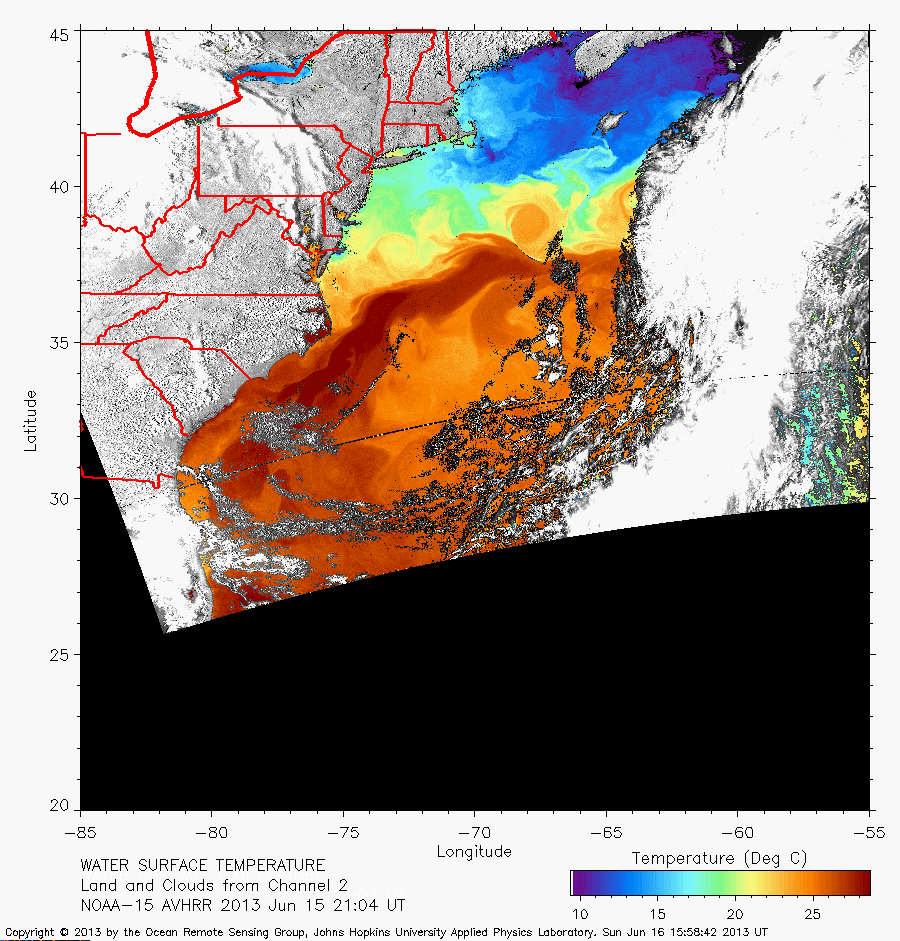
We sailed out past the Bay Bridge Tunnel again but this time had much nicer weather. We had a course laid out with waypoints that would take advantage of the current in the Gulf Stream and it's meanders. The meanders are warm and cold water swirls that can give you an extra boost in speed if you catch them right. Our course took us down to Hatteras, NC where we'd then head east and pick up the Gulf Stream.

All the way out that first day we constantly heard radio transmissions of Navy ships saying they were going to be having firing practice in such and such an area and all vessels were to stand clear. OK, no problem. At 1900, 7pm, we heard this deafening explosion that sounded like it was directly overhead. It was huge, so big it left us both stunned.  We felt like we'd been kicked in the gut.   There were no other boats in the vicinity so I got on the radio, gave our location and said that if anyone was firing guns in our vicinity to please take note of our location. No response. A few minutes later we got a call on the radio from the Coast Guard. They wanted to know exactly what had happened. I asked if there were any Navy vessels nearby and they said no. Hmmm. They asked if we had seen any smoke or fire, could we tell the direction of the explosion, etc. After about 15 minutes of chit chat we saw a Coast Guard helicopter fly by very low over the water. He went a few miles past us and then flew south across our bow. As we sailed on we saw him hovering over a spot about 1.5 miles from where we had been. I don't know what happened but I suspect what we heard was a boat exploding due to a propane leak. Gotta check the Norfolk or maybe even N. Carolina news for more info on this.

The next day was the day we crossed into the Gulf Stream. The water was a nice emerald green, the air was cool, maybe mid 70's, sky was clear and the water was kinda choppy. Off in the distance I could see a line in the water running north and south. As we got closer it became very obvious. It looked like we were coming to an intersection on a road. As we entered the Gulf Stream we picked up speed considerably, at one point reaching 10.4 knots, up from an average 6.5 knots before. Also, the water changed. The color went from emerald green to this beautiful deep, dark blue. Cheri says it's called Circadian Blue in artist's paint. The surface also changed from choppy to fairly smooth with huge rolling swells. Plus the air temperature went up at least 10 degrees. It was really amazing.

We made good time crossing the Gulf Stream. We averaged 8.5 knots, a two knot boost in speed. We saw Portuguese Men of War but at first thought they were plastic bottles. They're about the same size which surprised me because I always thought they were bigger than that. Maybe these are dwarves or something. We also had a pod of dolphins swim around our boat for a while. Pretty cool. About half way across we hove-to for four hours just to take a break and relax, enjoy the beauty around us. We ran the genset and recharged the batteries, had lunch and smoked cigars. This made for a memorable break in the trip.

On our fourth day out we encountered several thunder heads. The first one I easily avoided but the second one outsmarted me and blasted us with 25 knot winds and rain. We managed to sail around the west side of the storm but on the backside we found rough conditions with 20 to 25 knot constant wind and waves that were easily 6 to 10 feet. Worse than that they were coming from three different directions. Our auto pilot was having a difficult time with it so I took over to prevent damaging the drive motor. I ended up steering for 12 hours. The storm dissipated overnight. By the next morning the seas were calmer and the wind was down to about 15 or 20 knots. We were only about 40 miles from Bermuda by first light and were picking up radio calls from Bermuda Radio.

In Bermuda they take navigation in their waters very seriously.  The island was originally discovered in 1609 when a supply ship for Jamestown, VA. ran onto the reef.  Today there are at least 150 known wrecks, possibly as many as 300.   Because of this the reefs and channels are now well marked and Bermuda Radio monitors and guides every ship in and out of the area.

The final day of our trip over, Tuesday, the wind was blowing about 15 knots SE, directly from where we wanted to go. We ran the rest of the way in under power/sail and arrived at Customs around 1300. We dressed up in nice clothes for check-in just for fun. When we finished up the paperwork we went back out to the boat and found Bob, from Starshine, in his dinghy. He had seen us come in and wanted to let us know they were tied up at St. George's Sports and Dinghy Club. We hadn't made any firm plans on where to park the boat so we headed over there. On the way I ran over a sunken paddle wheeler from the 1800's, scraping the fresh paint off the bottom of our keel. Luckily there was no other damage.  We mighta been #301 on the wreck register!  Ya really gotta watch where you're going!

The Dinghy Club has a concrete wall that encloses the slips and protects them from the rougher waters of the harbor.  We tied up alongside the outside of this wall behind Starshine in about eight feet of crystal clear water. We had originally planned to only stay in the marina for a few days while we recovered from the trip over.  Because of our "altered schedule" and the fact that we liked it so much in St. George's we decided to stay the whole time at the marina.  It was pretty cheap there too and I guess that mighta played into it also.  I don't think it was even a half mile walk into town and the view was great along the way.

The town of St. George is the original settlement and has over 40 buildings from the 1600's.  It's clean and quaint and the people are fantastic.  We found the people of Bermuda to be the friendliest of anywhere we've been.  Forgiving too.  I kept stepping out into oncoming traffic because they drive on the wrong side over there (someone should tell them!).  No horns, no getting flipped off and no screaming obscenities.  People would wave and laugh and go out of their way to be nice to us and to each other too.  They may have been thinking "there goes that idiot from the States walking out in traffic again" but they kept it to themselves.

There is no source of fresh water in Bermuda so they collect rainwater from their roof and direct it into a cistern.  Everyone on the East end of the island does this.  On the other end in the city of Hamilton they have a desalination plant for their drinking water.  The picture shows where we tied up to clear Customs when we first arrived.  It also shows the rooftop water collection system (yellow building) and pipes running down to the cistern.  Pretty cool.  And that rust is a real flavor enhancer.

We only spent one day on the other end of the island.  We took the ferry from St. George over to Ireland Island where the old Navy Yard is.  The painting at the top is of the Navy Yard in the 1800's.  It's now a major tourist site with a museum at the old fort and most of the buildings in the Yard have been converted over to a Mall full of great shops, many featuring local artists.  We spent a few hours at the museum, walked around the fort and the Mall and then took another ferry into Hamilton.  We got there at 1800, 6pm, just as they were rolling up the sidewalks.  We walked around for a bit and then caught the bus back to St. George.  The bus ride was all locals going home from work so we got to see the non-tourist side of Bermuda.  In the end we found we really preferred the East end of the island because of it's small town feel, old buildings, narrow streets and smaller crowds.

Another interesting thing we found on the East end....apparently someone is making a killing knitting sweaters for trees and large shrubs.  We saw these all over the place.  We're thinking about having one done for our mast.

So, to finish up Part 2 I'd like to make an observation.  Wind and waves on the Atlantic are very different from wind and waves on the Chesapeake Bay.  You may be sitting there thinking "duh" but what I mean is this.....we've sailed in 40 to 45 knot winds on the Bay and it kicks up these 6' high, short period waves that are really nothing more than a nuisance and they make for an uncomfortable ride.  Out on the Atlantic we saw 25 knot winds with 10' waves on our way out and coming back we had one day with 28 to 35 knot winds and 15' seas.  Maybe bigger.  This was somewhat more than just a nuisance.  It was like being on a roller coaster for 12 hours.  No, it was worse because it required constant attention and hand steering just to get through it safely.  I'll go into more detail in Part 3 but my point is, it's much bigger out there.  25 knot wind on the Chesapeake Bay is when it's just getting interesting on an Island Packet because the boat weighs so much.  25 knot wind on the ocean is a whole different game.  Next time I look at those GRIB files I'll have a whole lot more respect for 2.5 feathers.

Monday, June 17, 2013

Bermuda Run, Part 1


 This all started out with a plan to sail around the DelMarVa peninsula to give us a chance to experience overnight and off-shore sailing.  We had originally planned to do this in May 2012 but our plans fell through when we got an offer on our boat two weeks before we were supposed to depart.  We cancelled our vacation and after about a month of negotiation with the buyers the deal fell through.  We eventually took our boat off the market.  In November 2012 we again began making plans for the DelMarVa run and had several other boats interested in going along.  Just as we began making solid plans we heard about an Island Packet rally to Bermuda that was being planned for the same time, late May 2013.  It took us about two minutes of discussion before we dumped our plans for the DelMarVa and signed on for Bermuda.  At that time we were the twelfth boat to sign up for the rally.

Once we signed up several months went by before we heard another word.  We wrote to the organizer and offered assistance but he felt he had things under control.  In January he asked everyone to make a commitment and over half the boats dropped out.  After that we heard nothing for several more months.  I wasn't sure what the organizer had in mind but I didn't feel too comfortable with the lack of organization.  At the end of April we got an e-mail from him saying his brother and only crew member had passed away and he would have to drop out of the rally.  That left us with four boats and no organizer.  Of the four only one had been to Bermuda before and that boat quickly dropped out also.  The remaining three of us got in touch with each other and got things rolling, shared information and within days had things feeling much more organized than at any time in the previous five months.  We had at this point less than thirty days to go.  Within two weeks we were down to just two boats, La Vida Dulce and Starshine.

Starshine has a Single Side-Band radio which is essential for getting weather updates out at sea.  We signed up with Dane and Jennifer Clark for weather routing to get suggestions for the best times to go and return and also got info on how to take advantage of swirling currents of the Gulf Stream to increase our speed.  We also shared info on a life raft rental company in Hampton, VA and we each signed on with them for six-man life rafts.  Cheri spent the final weekend before we left at her brother's house making meals for 30 days in advance and freezing them.  I spent all my time getting the auto pilot and depth sounder installed.  We also picked up our safety harnesses and jacklines.  So much to do and it was getting down to the final moments.

Our original intent was to leave our marina by 5/21 but with all the preparations we decided to hold off for one more day and departed for Hampton on 5/23 around 0700. We were supposed to meet up with Starshine, IP380, and the plan was to depart on 5/25 or 5/26. We figured we had a few days to get down to Hampton and could take our time. Once out in the Bay we found a stiff breeze of about 20 knots coming straight out of the South, the direction we needed to go. We also needed to do the initial setup for the auto pilot so we decided to run under power for a while.

The procedure for setting up the auto pilot is pretty simple and starts out with "swinging the compass", which involves driving in slow circles to calibrate the fluxgate compass. It then goes into some pre-programmed maneuvers. We ran into problems with the maneuvers and it failed every time. We called the tech service for Raymarine which includes being on hold and listening to Classical Gas over and over for 45 minutes. We went through that six times before we finally got the problem straightened out. It turned out that when I installed the rudder reference I had to mount it upside down because there just wasn't any other way to get it to fit. On the sixth call I remembered this and the tech said I simply needed to swap the red and green wires from the rudder reference. That worked and we were up and running. This took about 3 hours with me in the cockpit locker for most of that time while Cheri drove the boat towards our destination.

While all this was going on we received an e-mail from Starshine saying they wanted to depart from Hampton on 5/24. Uhm, no problem. We'll just do our fist overnight run now, get it out of the way. Which we did. We ran under power the entire way, 6.5 knots, straight into the wind. We actually arrived in the area around 0230 but drove around in the dark until the sun came up before attempting the entrance into Salt Pond. We pulled into Southall Landings Marina at 0700. As we turned into the slip next to Starshine it began to rain. I mean pour.

As soon as we got the boat tied up the owner of Starshine came aboard to discuss our trip to Bermuda. We were expecting to depart within a few hours. As Bob ducked under the canvass entry to our cockpit he caught his foot on the coaming and flew across the cockpit, landing head first on the edge of the seat on the other side. I don't mean he stumbled either. He was literally completely in the air when his face came in contact with the seat. I was sure he'd be dead. I rolled him over and blood just gushed out of his nose. He said he was OK but couldn't see straight and all I could think was that he had a concussion. I took him down to the hospital where X-rays showed nothing. They were going to let him go when he mentioned that he had double vision. That got him a CT scan which showed five broken bones in his face and the doctor wanted him transferred over to a hospital in Norfolk right away for emergency surgery. Bob felt good enough, no pain, that he decided to go back to his boat first and we could take him over to Norfolk later. When he called the hospital to make arrangements they wanted him to wait until the following Tuesday for surgery and then he'd have to wait at least a week for a follow up. This all happened Friday morning, the weekend of Memorial Day. At this point it looked like the trip to Bermuda was out.

Cheri and I discussed things and decided to make the trip alone. We borrowed Bob's car and drove into Norfolk to get our rented life raft. On the way back Cheri mentioned getting someone to sign on with us to help make standing watches a little easier. I told her there were very few people I would trust with our boat, much less get along with in close quarters for extended periods of time. One person came to mind, Jeff Arnfield. Cheri had worked with him at NOAA and we had met on a trip to Asheville, North Carolina. Great guy and an avid sailor. Thinking it was too short notice and would never happen Cheri contacted him anyway with the offer and he jumped on it, drove 7 hours and arrived Saturday afternoon. This was meant to be!

In the meantime Bob had gotten in touch with another doctor and made an appointment for Tuesday. There was now a chance that he'd still be able to go but he didn't have his rented life raft and would have to wait until Tuesday to get it. We were now locked in to leave on Sunday morning because Jeff could only go for the first half and had a flight out of Bermuda on the following Monday, 6/3 to come home. Hold on, it gets even more complex.

We took off early Sunday morning and as soon as we cleared the marker for Salt Pond we attempted to set the mainsail. It jammed in the slot about 2/3 up the mast and we could not get it in or out. In our efforts we put too much tension on the roller reefing line and blew out a pad-eye holding one of the blocks at the base of the mast. We turned around and went back to the marina.

I knew right away what the problem was. I had just recently adjusted the standing rigging to factory specs and I knew this had to be the cause of the problem.  It's been my experience that whenever anything goes wrong you should always look at the most recent thing done. When I eyed up the mast I could see the top begin to bend aft slightly right near where the sail was jamming. I looked on the Internet and found a write-up done by an IP dealer who said that the factory specs were wrong and he had a procedure for doing it correctly.

I also found a good explanation for what the problem was. When there's a bend in the mast with in-mast roller reefing it causes the spool that the sail rolls onto to come in contact with the inside of the mast. Let me try that again. The mast is hollow and has this spool inside that the sail rolls onto. The spool is only connected at the top and bottom so if the mast bends the spool is still straight. Now where the mast begins to bend the spool is closer to the inside in one area and the sail will rub inside the the mast and bunch up. The mast has to be perfectly straight with this type of roller reefing.

Jeff and I went through the modified procedure of adjusting the rigging.  The standing rigging is the wires that hold up the mast fore and aft and side to side.  The rigging on the sides extend up to different heights on the mast to keep it stiff and straight over it's full height.  We found the adjustments to the forward and aft lowers on Port and Starboard to be the critical changes.  Now the mast stood perfectly straight and best of all, the sail rolled in and out better than it ever had since we bought the boat. This has always been a problem and up until now I've really hated in-mast roller reefing. Another mystery solved and I now have a much better understanding of how this all works.  We replaced the blown out pad-eye and were now ready to go again.

Leaving Sunday was no longer an option though. In the midst of all this Bob had talked with his doctor and was told that surgery wasn't necessary and that the bones would heal fine if just left alone. He wasn't in any pain and the swelling had gone down almost completely. We decided to wait until Tuesday so we could sail out together.

We departed for Bermuda Tuesday morning at 1100. We sailed past the Bay Bridge Tunnel and continued out into the Atlantic. Conditions were brisk with 22 knot winds and about a 6 foot chop. Thirty two miles out from the bridge at 1900 our mainsail blew out, torn in three places. Jeff and I went up on deck and dropped the sail and tied it down to the boom, fearing that if we tried to furl it into the mast we'd never get it back out. It was really shredded. With things secured we got on the radio and told Starshine our trip was over and we were headed back. They decided to continue on to Bermuda.

We returned to Salt Pond around 0100 with Jeff standing on deck with our mega candlepower spot light to show the way past the unlighted channel markers. This place is totally dark at night.
The next morning we called around and found a local canvas shop, Signature Canvas. The owner kept his boat at Southall Landings Marina and told us if we could get the sail to him by 1000 he'd take a look at it. We were at his door at 0959. He laid the sail out and inspected it. He felt that the stitching was in good shape and repairs would be possible. He said he could have it back to us later that day for about $400. Wow! We're saved!

Back at the boat Jeff decided he couldn't continue on the trip because of time constraints. There was no way we'd get to Bermuda in time for his return flight and he didn't think he could get any more time off from work. Understood. After a short stay and all kinds of great help on the boat he packed up and drove home. Bummer.

Around 1600 I called to see how the repair was coming along. "It's finished, come on down and pick it up". Wow! That's fast! Only problem is we now had no transportation. "No problem, we'll deliver it to the dock, no extra charge". These people are incredible.

Cheri and I got the main back up. Couldn't even tell it was patched. She wanted to take off that night but I was just too beat so we decided to wait until the next day to take off. Again.

So now it's a week after we had originally planned to go. We still have time to get there and back but we're eating into the time we have to actually be there and enjoy the place. Not only that but now we're going alone, just the two of us (and Bella), just La Vida Dulce, and we're gonna be pretty tired when we get there so that's gonna cost a day or so too.

This is pretty crazy.  We started out as a group of twelve boats, plenty of comfort in a large group.  We were now down to going it alone.  The thing is, we'd come this far and done so much to prepare for this.  It just didn't make sense to quit.  On top of that, we would eventually be doing this on our own anyway.  Might as well jump in with both feet.  Besides, all the bad stuff had already happened.  What else could go wrong?