Tuesday, June 18, 2013

Bermuda Run, Part 2


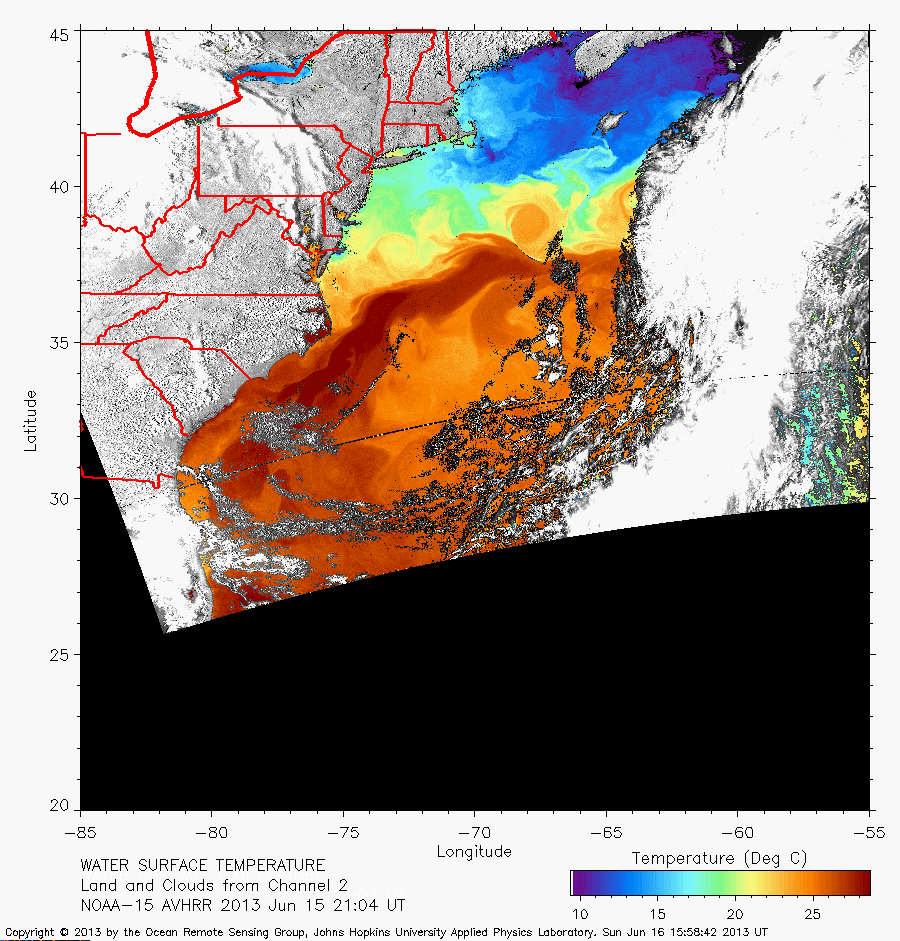
We sailed out past the Bay Bridge Tunnel again but this time had much nicer weather. We had a course laid out with waypoints that would take advantage of the current in the Gulf Stream and it's meanders. The meanders are warm and cold water swirls that can give you an extra boost in speed if you catch them right. Our course took us down to Hatteras, NC where we'd then head east and pick up the Gulf Stream.

All the way out that first day we constantly heard radio transmissions of Navy ships saying they were going to be having firing practice in such and such an area and all vessels were to stand clear. OK, no problem. At 1900, 7pm, we heard this deafening explosion that sounded like it was directly overhead. It was huge, so big it left us both stunned.  We felt like we'd been kicked in the gut.   There were no other boats in the vicinity so I got on the radio, gave our location and said that if anyone was firing guns in our vicinity to please take note of our location. No response. A few minutes later we got a call on the radio from the Coast Guard. They wanted to know exactly what had happened. I asked if there were any Navy vessels nearby and they said no. Hmmm. They asked if we had seen any smoke or fire, could we tell the direction of the explosion, etc. After about 15 minutes of chit chat we saw a Coast Guard helicopter fly by very low over the water. He went a few miles past us and then flew south across our bow. As we sailed on we saw him hovering over a spot about 1.5 miles from where we had been. I don't know what happened but I suspect what we heard was a boat exploding due to a propane leak. Gotta check the Norfolk or maybe even N. Carolina news for more info on this.

The next day was the day we crossed into the Gulf Stream. The water was a nice emerald green, the air was cool, maybe mid 70's, sky was clear and the water was kinda choppy. Off in the distance I could see a line in the water running north and south. As we got closer it became very obvious. It looked like we were coming to an intersection on a road. As we entered the Gulf Stream we picked up speed considerably, at one point reaching 10.4 knots, up from an average 6.5 knots before. Also, the water changed. The color went from emerald green to this beautiful deep, dark blue. Cheri says it's called Circadian Blue in artist's paint. The surface also changed from choppy to fairly smooth with huge rolling swells. Plus the air temperature went up at least 10 degrees. It was really amazing.

We made good time crossing the Gulf Stream. We averaged 8.5 knots, a two knot boost in speed. We saw Portuguese Men of War but at first thought they were plastic bottles. They're about the same size which surprised me because I always thought they were bigger than that. Maybe these are dwarves or something. We also had a pod of dolphins swim around our boat for a while. Pretty cool. About half way across we hove-to for four hours just to take a break and relax, enjoy the beauty around us. We ran the genset and recharged the batteries, had lunch and smoked cigars. This made for a memorable break in the trip.

On our fourth day out we encountered several thunder heads. The first one I easily avoided but the second one outsmarted me and blasted us with 25 knot winds and rain. We managed to sail around the west side of the storm but on the backside we found rough conditions with 20 to 25 knot constant wind and waves that were easily 6 to 10 feet. Worse than that they were coming from three different directions. Our auto pilot was having a difficult time with it so I took over to prevent damaging the drive motor. I ended up steering for 12 hours. The storm dissipated overnight. By the next morning the seas were calmer and the wind was down to about 15 or 20 knots. We were only about 40 miles from Bermuda by first light and were picking up radio calls from Bermuda Radio.

In Bermuda they take navigation in their waters very seriously.  The island was originally discovered in 1609 when a supply ship for Jamestown, VA. ran onto the reef.  Today there are at least 150 known wrecks, possibly as many as 300.   Because of this the reefs and channels are now well marked and Bermuda Radio monitors and guides every ship in and out of the area.

The final day of our trip over, Tuesday, the wind was blowing about 15 knots SE, directly from where we wanted to go. We ran the rest of the way in under power/sail and arrived at Customs around 1300. We dressed up in nice clothes for check-in just for fun. When we finished up the paperwork we went back out to the boat and found Bob, from Starshine, in his dinghy. He had seen us come in and wanted to let us know they were tied up at St. George's Sports and Dinghy Club. We hadn't made any firm plans on where to park the boat so we headed over there. On the way I ran over a sunken paddle wheeler from the 1800's, scraping the fresh paint off the bottom of our keel. Luckily there was no other damage.  We mighta been #301 on the wreck register!  Ya really gotta watch where you're going!

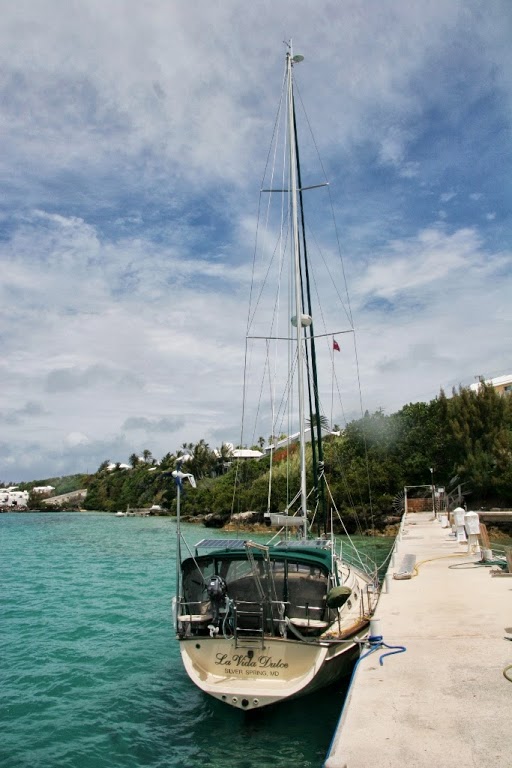
The Dinghy Club has a concrete wall that encloses the slips and protects them from the rougher waters of the harbor.  We tied up alongside the outside of this wall behind Starshine in about eight feet of crystal clear water. We had originally planned to only stay in the marina for a few days while we recovered from the trip over.  Because of our "altered schedule" and the fact that we liked it so much in St. George's we decided to stay the whole time at the marina.  It was pretty cheap there too and I guess that mighta played into it also.  I don't think it was even a half mile walk into town and the view was great along the way.

The town of St. George is the original settlement and has over 40 buildings from the 1600's.  It's clean and quaint and the people are fantastic.  We found the people of Bermuda to be the friendliest of anywhere we've been.  Forgiving too.  I kept stepping out into oncoming traffic because they drive on the wrong side over there (someone should tell them!).  No horns, no getting flipped off and no screaming obscenities.  People would wave and laugh and go out of their way to be nice to us and to each other too.  They may have been thinking "there goes that idiot from the States walking out in traffic again" but they kept it to themselves.

There is no source of fresh water in Bermuda so they collect rainwater from their roof and direct it into a cistern.  Everyone on the East end of the island does this.  On the other end in the city of Hamilton they have a desalination plant for their drinking water.  The picture shows where we tied up to clear Customs when we first arrived.  It also shows the rooftop water collection system (yellow building) and pipes running down to the cistern.  Pretty cool.  And that rust is a real flavor enhancer.

We only spent one day on the other end of the island.  We took the ferry from St. George over to Ireland Island where the old Navy Yard is.  The painting at the top is of the Navy Yard in the 1800's.  It's now a major tourist site with a museum at the old fort and most of the buildings in the Yard have been converted over to a Mall full of great shops, many featuring local artists.  We spent a few hours at the museum, walked around the fort and the Mall and then took another ferry into Hamilton.  We got there at 1800, 6pm, just as they were rolling up the sidewalks.  We walked around for a bit and then caught the bus back to St. George.  The bus ride was all locals going home from work so we got to see the non-tourist side of Bermuda.  In the end we found we really preferred the East end of the island because of it's small town feel, old buildings, narrow streets and smaller crowds.

Another interesting thing we found on the East end....apparently someone is making a killing knitting sweaters for trees and large shrubs.  We saw these all over the place.  We're thinking about having one done for our mast.

So, to finish up Part 2 I'd like to make an observation.  Wind and waves on the Atlantic are very different from wind and waves on the Chesapeake Bay.  You may be sitting there thinking "duh" but what I mean is this.....we've sailed in 40 to 45 knot winds on the Bay and it kicks up these 6' high, short period waves that are really nothing more than a nuisance and they make for an uncomfortable ride.  Out on the Atlantic we saw 25 knot winds with 10' waves on our way out and coming back we had one day with 28 to 35 knot winds and 15' seas.  Maybe bigger.  This was somewhat more than just a nuisance.  It was like being on a roller coaster for 12 hours.  No, it was worse because it required constant attention and hand steering just to get through it safely.  I'll go into more detail in Part 3 but my point is, it's much bigger out there.  25 knot wind on the Chesapeake Bay is when it's just getting interesting on an Island Packet because the boat weighs so much.  25 knot wind on the ocean is a whole different game.  Next time I look at those GRIB files I'll have a whole lot more respect for 2.5 feathers.

Monday, June 17, 2013

Bermuda Run, Part 1


 This all started out with a plan to sail around the DelMarVa peninsula to give us a chance to experience overnight and off-shore sailing.  We had originally planned to do this in May 2012 but our plans fell through when we got an offer on our boat two weeks before we were supposed to depart.  We cancelled our vacation and after about a month of negotiation with the buyers the deal fell through.  We eventually took our boat off the market.  In November 2012 we again began making plans for the DelMarVa run and had several other boats interested in going along.  Just as we began making solid plans we heard about an Island Packet rally to Bermuda that was being planned for the same time, late May 2013.  It took us about two minutes of discussion before we dumped our plans for the DelMarVa and signed on for Bermuda.  At that time we were the twelfth boat to sign up for the rally.

Once we signed up several months went by before we heard another word.  We wrote to the organizer and offered assistance but he felt he had things under control.  In January he asked everyone to make a commitment and over half the boats dropped out.  After that we heard nothing for several more months.  I wasn't sure what the organizer had in mind but I didn't feel too comfortable with the lack of organization.  At the end of April we got an e-mail from him saying his brother and only crew member had passed away and he would have to drop out of the rally.  That left us with four boats and no organizer.  Of the four only one had been to Bermuda before and that boat quickly dropped out also.  The remaining three of us got in touch with each other and got things rolling, shared information and within days had things feeling much more organized than at any time in the previous five months.  We had at this point less than thirty days to go.  Within two weeks we were down to just two boats, La Vida Dulce and Starshine.

Starshine has a Single Side-Band radio which is essential for getting weather updates out at sea.  We signed up with Dane and Jennifer Clark for weather routing to get suggestions for the best times to go and return and also got info on how to take advantage of swirling currents of the Gulf Stream to increase our speed.  We also shared info on a life raft rental company in Hampton, VA and we each signed on with them for six-man life rafts.  Cheri spent the final weekend before we left at her brother's house making meals for 30 days in advance and freezing them.  I spent all my time getting the auto pilot and depth sounder installed.  We also picked up our safety harnesses and jacklines.  So much to do and it was getting down to the final moments.

Our original intent was to leave our marina by 5/21 but with all the preparations we decided to hold off for one more day and departed for Hampton on 5/23 around 0700. We were supposed to meet up with Starshine, IP380, and the plan was to depart on 5/25 or 5/26. We figured we had a few days to get down to Hampton and could take our time. Once out in the Bay we found a stiff breeze of about 20 knots coming straight out of the South, the direction we needed to go. We also needed to do the initial setup for the auto pilot so we decided to run under power for a while.

The procedure for setting up the auto pilot is pretty simple and starts out with "swinging the compass", which involves driving in slow circles to calibrate the fluxgate compass. It then goes into some pre-programmed maneuvers. We ran into problems with the maneuvers and it failed every time. We called the tech service for Raymarine which includes being on hold and listening to Classical Gas over and over for 45 minutes. We went through that six times before we finally got the problem straightened out. It turned out that when I installed the rudder reference I had to mount it upside down because there just wasn't any other way to get it to fit. On the sixth call I remembered this and the tech said I simply needed to swap the red and green wires from the rudder reference. That worked and we were up and running. This took about 3 hours with me in the cockpit locker for most of that time while Cheri drove the boat towards our destination.

While all this was going on we received an e-mail from Starshine saying they wanted to depart from Hampton on 5/24. Uhm, no problem. We'll just do our fist overnight run now, get it out of the way. Which we did. We ran under power the entire way, 6.5 knots, straight into the wind. We actually arrived in the area around 0230 but drove around in the dark until the sun came up before attempting the entrance into Salt Pond. We pulled into Southall Landings Marina at 0700. As we turned into the slip next to Starshine it began to rain. I mean pour.

As soon as we got the boat tied up the owner of Starshine came aboard to discuss our trip to Bermuda. We were expecting to depart within a few hours. As Bob ducked under the canvass entry to our cockpit he caught his foot on the coaming and flew across the cockpit, landing head first on the edge of the seat on the other side. I don't mean he stumbled either. He was literally completely in the air when his face came in contact with the seat. I was sure he'd be dead. I rolled him over and blood just gushed out of his nose. He said he was OK but couldn't see straight and all I could think was that he had a concussion. I took him down to the hospital where X-rays showed nothing. They were going to let him go when he mentioned that he had double vision. That got him a CT scan which showed five broken bones in his face and the doctor wanted him transferred over to a hospital in Norfolk right away for emergency surgery. Bob felt good enough, no pain, that he decided to go back to his boat first and we could take him over to Norfolk later. When he called the hospital to make arrangements they wanted him to wait until the following Tuesday for surgery and then he'd have to wait at least a week for a follow up. This all happened Friday morning, the weekend of Memorial Day. At this point it looked like the trip to Bermuda was out.

Cheri and I discussed things and decided to make the trip alone. We borrowed Bob's car and drove into Norfolk to get our rented life raft. On the way back Cheri mentioned getting someone to sign on with us to help make standing watches a little easier. I told her there were very few people I would trust with our boat, much less get along with in close quarters for extended periods of time. One person came to mind, Jeff Arnfield. Cheri had worked with him at NOAA and we had met on a trip to Asheville, North Carolina. Great guy and an avid sailor. Thinking it was too short notice and would never happen Cheri contacted him anyway with the offer and he jumped on it, drove 7 hours and arrived Saturday afternoon. This was meant to be!

In the meantime Bob had gotten in touch with another doctor and made an appointment for Tuesday. There was now a chance that he'd still be able to go but he didn't have his rented life raft and would have to wait until Tuesday to get it. We were now locked in to leave on Sunday morning because Jeff could only go for the first half and had a flight out of Bermuda on the following Monday, 6/3 to come home. Hold on, it gets even more complex.

We took off early Sunday morning and as soon as we cleared the marker for Salt Pond we attempted to set the mainsail. It jammed in the slot about 2/3 up the mast and we could not get it in or out. In our efforts we put too much tension on the roller reefing line and blew out a pad-eye holding one of the blocks at the base of the mast. We turned around and went back to the marina.

I knew right away what the problem was. I had just recently adjusted the standing rigging to factory specs and I knew this had to be the cause of the problem.  It's been my experience that whenever anything goes wrong you should always look at the most recent thing done. When I eyed up the mast I could see the top begin to bend aft slightly right near where the sail was jamming. I looked on the Internet and found a write-up done by an IP dealer who said that the factory specs were wrong and he had a procedure for doing it correctly.

I also found a good explanation for what the problem was. When there's a bend in the mast with in-mast roller reefing it causes the spool that the sail rolls onto to come in contact with the inside of the mast. Let me try that again. The mast is hollow and has this spool inside that the sail rolls onto. The spool is only connected at the top and bottom so if the mast bends the spool is still straight. Now where the mast begins to bend the spool is closer to the inside in one area and the sail will rub inside the the mast and bunch up. The mast has to be perfectly straight with this type of roller reefing.

Jeff and I went through the modified procedure of adjusting the rigging.  The standing rigging is the wires that hold up the mast fore and aft and side to side.  The rigging on the sides extend up to different heights on the mast to keep it stiff and straight over it's full height.  We found the adjustments to the forward and aft lowers on Port and Starboard to be the critical changes.  Now the mast stood perfectly straight and best of all, the sail rolled in and out better than it ever had since we bought the boat. This has always been a problem and up until now I've really hated in-mast roller reefing. Another mystery solved and I now have a much better understanding of how this all works.  We replaced the blown out pad-eye and were now ready to go again.

Leaving Sunday was no longer an option though. In the midst of all this Bob had talked with his doctor and was told that surgery wasn't necessary and that the bones would heal fine if just left alone. He wasn't in any pain and the swelling had gone down almost completely. We decided to wait until Tuesday so we could sail out together.

We departed for Bermuda Tuesday morning at 1100. We sailed past the Bay Bridge Tunnel and continued out into the Atlantic. Conditions were brisk with 22 knot winds and about a 6 foot chop. Thirty two miles out from the bridge at 1900 our mainsail blew out, torn in three places. Jeff and I went up on deck and dropped the sail and tied it down to the boom, fearing that if we tried to furl it into the mast we'd never get it back out. It was really shredded. With things secured we got on the radio and told Starshine our trip was over and we were headed back. They decided to continue on to Bermuda.

We returned to Salt Pond around 0100 with Jeff standing on deck with our mega candlepower spot light to show the way past the unlighted channel markers. This place is totally dark at night.
The next morning we called around and found a local canvas shop, Signature Canvas. The owner kept his boat at Southall Landings Marina and told us if we could get the sail to him by 1000 he'd take a look at it. We were at his door at 0959. He laid the sail out and inspected it. He felt that the stitching was in good shape and repairs would be possible. He said he could have it back to us later that day for about $400. Wow! We're saved!

Back at the boat Jeff decided he couldn't continue on the trip because of time constraints. There was no way we'd get to Bermuda in time for his return flight and he didn't think he could get any more time off from work. Understood. After a short stay and all kinds of great help on the boat he packed up and drove home. Bummer.

Around 1600 I called to see how the repair was coming along. "It's finished, come on down and pick it up". Wow! That's fast! Only problem is we now had no transportation. "No problem, we'll deliver it to the dock, no extra charge". These people are incredible.

Cheri and I got the main back up. Couldn't even tell it was patched. She wanted to take off that night but I was just too beat so we decided to wait until the next day to take off. Again.

So now it's a week after we had originally planned to go. We still have time to get there and back but we're eating into the time we have to actually be there and enjoy the place. Not only that but now we're going alone, just the two of us (and Bella), just La Vida Dulce, and we're gonna be pretty tired when we get there so that's gonna cost a day or so too.

This is pretty crazy.  We started out as a group of twelve boats, plenty of comfort in a large group.  We were now down to going it alone.  The thing is, we'd come this far and done so much to prepare for this.  It just didn't make sense to quit.  On top of that, we would eventually be doing this on our own anyway.  Might as well jump in with both feet.  Besides, all the bad stuff had already happened.  What else could go wrong?

Tuesday, April 9, 2013

The Perils of Pauline

When I was a little kid my parents had a favorite movie, or at least a favorite saying based on this movie, "The Perils Of Pauline".  In the movie if anything could happen to Pauline it did.  I can associate.  As I recall Pauline was quite a screamer.  Uh huh, me too.

This past Saturday we sailed out of Whitehall Bay and returned home to Herrington Harbour North.  We'd been gone for three long months exactly.  Not to mention exactly one month longer than we had planned.  Our sail home was very nice, a bit chilly at 55 degrees F with 15 to 20 knots of wind out of the NE.  We sailed on a broad reach down to Thomas Point light where the wind died down to about 10 knots and our speed dropped from 7 knots to about 4 or 5.  When we entered Herring Bay we cranked up the engine and ran for home.  It is sooooooo nice to be back home!

The work on the cabinetry is finished.  I'll post some pictures about that below.  We knew coming home that we'd have a busy weekend with cleaning the boat and moving back on board.  We'd been living in a small efficiency apartment for the last three months and almost everything we own had to be moved out by noon on Sunday.

So, we get back to the slip around 1500 on Saturday and I'm up on the dock hooking up the shore power and talking to our neighbors.  Cheri starts calling my name, each time getting a little more urgent, and finally says we have a major water leak down below.  Hmmm.  Maybe I'd better stop goofing off and go see what's up.  Turns out she opened the drawer under the starboard settee in the Salon and found water.  This is not good because under that drawer is the water heater and the pump and distribution manifold for fresh water on the boat.  On the other hand, if this is a fresh water leak it could be considered a good thing since at the very worst we could only take on 250 gallons.  That's still a lot of water to have sloshing around in your living quarters.

I opened up the settee, turned on the pump and looked at all the hoses and connections.  No sign of a leak, no running water.  In the compartment with the water heater I see plenty of water but no running water.  I stick my hand in and it's hot.  That's not good.  If all the hoses are in good condition, not leaking, then the only source of hot water is going to be the water heater itself.  I turned everything off and started soaking up the water.  Never made any progress.  The water heater holds 11 gallons.  At least, it's supposed to hold eleven gallons.  Ours was dumping it out all over the place.

I removed the five hoses; engine supply and return, over-pressure bleed off, cold in and hot out.  I disconnected the power and removed the screws from the front plate.  The rear plate is held down by simply sliding into a pocket/bracket.  The compartment this thing is in is only slightly larger than the water heater itself.  To get it out I used clothesline to form two loops around the housing and used these as handles to lift it out.  When I got it to the top of the compartment where the hatch sits the clearance was so tight the clothes line didn't want to pull through.  With Cheri's help I removed the clothesline while the heater was in the air and we lifted it out.

I went on-line and found that West Marine had a similar unit, same dimensions, same capacity, same layout.  I ran down to WM and bought the only one they had in stock.  It was now 1930 and we're barely halfway through.  With the two units sitting side by side I swapped out the brass water fittings and dragged the new unit over.  I gently sat her down into the compartment and she wedged right at the top hatchway.  What???  I checked the dimensions and found the new unit was 5/16" bigger in every direction.  Instead of taking it back I decided to make it work.  I got out the trusty old saber saw and notched the opening enough to slide this critter in.  I then found that the rear bracket was 3/8" wider and wouldn't fit inside the bracket.  Take it back out, cut down the rear bracket with a hack saw and try it again.  That worked so now it was time to drill the holes for the front bracket.  That was when I found I didn't have my drill, had put it in storage to get stuff outa the way while we moved back on board.  Grrrrrr.  Grrrrrrr.  Grrrrrrrrrrrrrr.  I tried punching holes with screwdrivers and other improper tools but eventually gave up for the night.
Next morning I got up in time to get the drill out of storage in Annapolis at 0600.  Back at the boat I drilled the holes in about two minutes and had the bracket mounted.  I got all the wiring connected and moved on to hooking up the hoses.  Piece of cake!  Not.   The heat exchanger hoses that run to and from the engine have a wire support embedded in the rubber, which is good.  But it makes it very difficult to get them onto the hose barbs, especially with only about 1.5" to work in.  Busted knuckles, blisters and a bucket of bad language didn't do the job.  Finally I struck on the idea of using Cheri's hair drier to warm up the hoses and they eventually went on, though not willingly.

In the end the damn thing worked.  We couldn't have any water, hot or cold, until I got this thing going so it wasn't something that could wait.  It probably would have been worthwhile to pay Butch to do the installation but I just couldn't stand the thought of paying someone else to do the work after all we just went through this winter.  Money wins out over common sense.  Here's a picture of the little monster.  Notice the notched hatchway.  Also notice the drawer slides that were in the way.  I used a gigantic screwdriver and pried them out of the way to make clearance.  All the connections are on the left side and none of them had enough length to connect with the heater out of the compartment.  That would have been way too easy.  Hopefully this little demon will last longer than all of us.  I know this episode has taken several years off of my life just in frustration.

 OK, here's some pictures of the galley.  I wasn't able to get the pictures to line up with the comments so just bear with me here.  The first one is from the Nav Station looking aft.  Shows the cool-man new faucet, the cutting board for the sink and the overall look of the galley. 

The second picture is a closer view of the aft end with the divided fridge and freezer set into the counter top.  On the right is the new cabinet under the companionway and the knife slot in the counter.

Next pic shows the corner cabinet behind the freezer.  This was built for our coffee maker and has a dedicated outlet behind that little cubby hole inside on the left.

 The next picture shows the new spice cabinet behind the stove.  The left side was kept taller to allow room for olive oil and taller bottles of cooking stuff.  That sounds technical, doesn't it?

The final two pictures are the before and after shots.  More storage, more counter space, overall better use of space.  Those faux louvered doors are the cat's meow.  The Corian is awesome, looks like yellow quartz.  We are extremely pleased with how nicely this turned out.  Would we do it again?  Hell no!


Thursday, April 4, 2013

Tomorrow, tomorrow........

It's been a while since I've done an update, about three weeks or so, and there's a lot to update.  Seems like the last place I left off was working on the Nav Station equipment panel so maybe I should pick up there.


The instrument panel is finished.  It actually turned out pretty good and almost everything is operational.  Almost.  The new panel was something that had been laying around for a while.  I knew it was a project that had to be done but I didn't have a good enough excuse to tackle it.  The need for a DC sub-panel made it happen.  The old panel (first picture) had some stuff that wasn't being used and a few items that didn't need to be mounted there.  It also had this humongous panel for the wind generator control that just didn't look right and hogged a lot of space.  I disassembled the panel and cut down the face plate, 1" narrower and 4" shorter.  Much better!  I then covered the instrument panel with masking tape to prevent chipping the nice black surface when I cut out the holes for the instruments.  I made templates for each instrument and laid it all out in a way that made the most sense to me.  Our instrument panel is usually covered on the right side by the monitor for our mini Mac computer.  With that in mind I put the instruments that would be used most often on the left side.  I tried to lay everything out in columns and it worked out to have some space left over beneath the sub-panel in case we wanted to go with a larger breaker panel some day.  With everything drawn out on the tape I drilled half inch holes in the corners of each instrument cutout and then used a jig saw on the straight cuts.  Reassembly was pretty straightforward and the actual wiring was easier than I expected.

Behind the instrument panel I glued a piece of 3/4" plywood against the inside of the hull and used that to mount two solar panel controllers.  These are daisy chained together and will be able to handle our new solar panel arrangement; two 85w panels and two 140w panels.  We needed separate controllers because you can't mix and match different sized panels and the combined current capacity was more than one could handle on it's own.  So now, when we get the panels all mounted we'll have a capacity of 450 watts and 38 amps.  That'll go a long way towards keeping those batteries charged.

With all that done I installed a new 50 amp breaker in the main DC panel and ran 8 gauge, 3 conductor wire to feed the sub panel.  I double checked everything twice over, doubly, and then powered up the sub panel.  Voltage checks checked out so I powered up the MFD (multi function display) and the backbone.  All the instruments powered up on the first try.  How cool is that?  In fact, everything worked except for the wind generator.  I pretty much expected that because when I was wiring that up I hit the back of the display board with the negative wire from the generator and got a spectacular arc.  I mean, I made some serious ozone.  I'm pretty sure I can get parts for that thing so I'm not real concerned.  Stuff happens.  I'm fairly excited about having the new i70 display at the Nav Station.  We'll be able to call up all kinds of information with that.  Pretty handy for when you're sitting at anchor and want to know what's going on up topside.

We got our cool man sonar transducer put in.  This has a twelve degree offset to account for the angle of the hull where it's mounted.  That'll make it look straight down and give us a true indication of depth.  It'll also give us a digital picture of the bottom  in something like a 20 to 40 degree window depending on the depth and the frequency.  It even has a temperature sensor so we can tell if the water's suitable for skinny dipping.


We also got the bottom painted.  This was the first time in three years and I'm pretty pleased with how well this paint holds up.  We're using Pettit Trinidad SR, a "hard", non-ablative paint.  I prepped the hull with a quick washdown in 30 degree weather.  It was snowing!  With that done I sanded the bottom from the waterline down.  We actually raised our waterline by about 2.5".  With all the weight we've added to the boat she sits down further in the water and gets a scumline on the boot stripe.  With the higher waterline we'll have about 1" of exposed bottom paint which'll keep her looking much better.  I gave her one single fresh coat over the entire bottom and a second coat on the "wear" areas like along the waterline and the leading edge and bottom of the keel and rudder.  Cheri repainted the boot stripe the original color, Jade Green, which is actually almost black with green highlights.  We also cleaned up the prop and the bow thruster and gave them some anti-fouling paint too.With all that done I polished and waxed the hull above the waterline.  La Vida Dulce is looking very smart these days, lemme tell ya.

One other thing we did was to paint a code onto the anchor chain so we could tell how much chain we have out when we anchor.  We used fluorescent yellow and green.  The yellow is one band for every 25' and the green is one band for every 100'.  As an example at 150' we have 2 yellow bands and 1 green band.  Simple but effective.  The chain is 300' long so this works out very nicely.  The previous owner had marked it with different colored wire ties but they turn brittle and fall off and then you don't know what you have.  The whole reason for knowing how much chain you have out is because for the anchor to dig in well you want to have between 5 and 7 times the depth of the water, plus the length of the chain from the surface to the deck, about 6' or 7' for us.  So in 10' of water we want to have about 60' to 80' of chain out.


Work in the galley is almost finished.The upper cabinets are mostly in and we've selected heights for the shelves.  The cabinet behind the stove has three shelves and will be used for spices mostly because it's not very deep.  Between this cabinet and the stove is a storage slot that holds the piece of Corian that sits on top of the stove.  The cabinets were all supposed to have louvered doors but we didn't think about the sliding doors.  These have to be about 1/4" thick so they can slide past each other.  The cabinet Dude came up with a very cool faux louver look that we decided to use on all the cabinets.  He also milled finger pulls into the door frames and inserted pieces of "ivory" from some old piano keys.  The cabinets are beautiful and they add so much more storage space.  This was a really worthwhile upgrade for the boat.

This week (1st week of April) she'll be launched and checked out before we take her home on Saturday.  There's still quite a bit of work to do but I think once we have her cleaned up and we're all moved back aboard we'll hafta take a break, light up a cigar and drink a toast to a successful winter project.  Uhm, projects.

Man-oh-man, it's gonna be sooooooo nice to be back home.