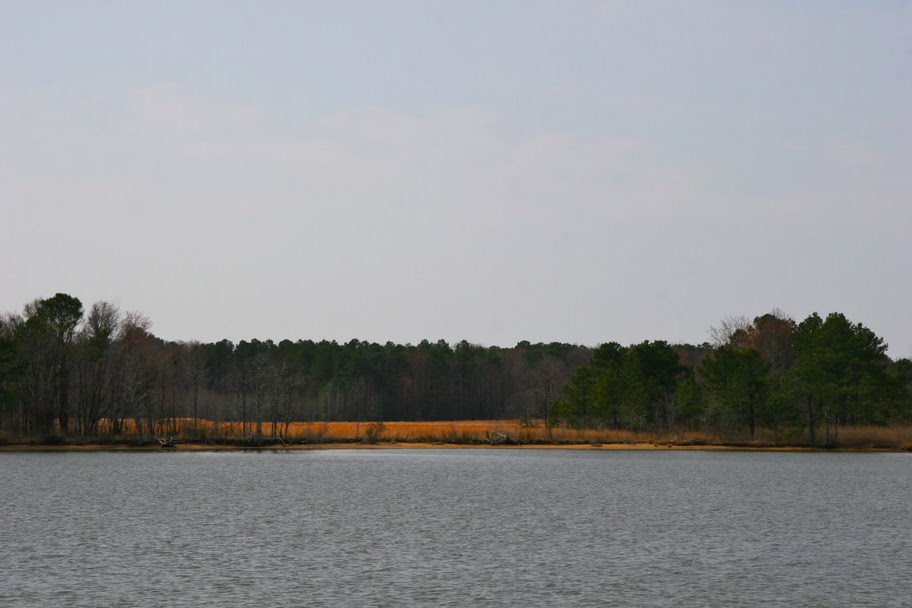
This past weekend, 5-13, we went sailing. I mean all weekend. On Friday (the 13th!!!) we had our good friends, Anthony and Luzma, join us for a day-sail. They showed up around 1130 with dishes of Peruvian food that Luzma had put together so we sat down for an early dinner. We hadn't seen these guys since last October so there was a lot of catching up to do. Around 1400 we cast off and headed out across the Bay, getting as far as R84A at the mouth of Eastern Bay. The wind was out of the SE at 15 to 20 kts, beautiful day. Anthony manned the helm for most of the way and we returned home by 1900. Good company, easy chit-chat, nice day for a sail.
The next day, Saturday, started out with heavy overcast skies and temps in the 60's. Cheri's nephew, Brian, and his wife, Katie, and their two year old daughter Kaitlyn joined us for a two day sail up to Osprey Point Marina in Rock Hall and back again. There's a really nice B+B there as well as a 5 star restaurant. Brian's parents had reserved a room for them at the B+B to celebrate their three year anniversary and we had volunteered to take care of Kaitlyn on the boat. Yikes!
We got the boat loaded up and headed out around 1100 in the middle of a torrential downpour with lightning flashing overhead. We had reservations for dinner at 1900 so we didn't really have time to wait it out. The rain continued until we cleared G83A just outside of Herring Bay. The sail up to Rock Hall took all of 7 hours with light winds out of the SE for most of the trip. We pulled into Osprey Point Marina at 1810 with little time to spare in getting ready for dinner. Cheri pushed our reservations back to 1945 so we'd all have a chance to get settled in.
Dinner was fantastic, a true gourmet delight. We checked out the kids' room before turning in for the night. They had two rooms overlooking the marina, a closet and a flushing toilet. Pretty swank! Back at the boat the three of us sat up and watched Finding Nemo. For the rest of the weekend Kaitlyn was searching the Bay for Nemo. The next morning, after a quick breakfast we headed out for the return trip to HHN. Winds were 15 kts out of the SSE which gave us a challenge all the way home, requiring tacking all the way down the Bay. The voyage started with our departure from Osprey Point. Motoring out of Swan Creek I misread the channel markers and turned at the wrong place and ran aground. Hitting the side of the dredged channel was like running into a brick wall, almost knocked Cheri overboard. I backed down hard, dragged the keel out of the mud and continued down the creek like nothing had ever happened. We ran down to GC#3 (green can #3) under power because the wind was right on our nose. Once we turned out into the Bay we unfurled the sails and cruised out in light but steady winds at 5 to 6 knots. Unable to pass straight under the Bay Bridge because the wind was blowing from directly behind it we began a series of tacking maneuvers that would last throughout most of the day. We tacked four times approaching the Bay Bridge and probably six more times just trying to get down to Thomas Point Light. Grrr. Every time I tried to overcompensate to get us additional room to maneuver the wind would shift just enough to throw everything off and we'd end up having to tack again to clear an obstacle. There were about six tankers parked out in the mooring field outside of Annapolis and on our final tack around Thomas Point we were interrupted by four loud blasts from behind us. One of the tankers was getting underway and we were directly in front of him. We made a quick turn to port and circled around behind him before continuing on our way.
At this point the wind was still coming directly out of where we wanted to go and a quick glance at my watch revealed that we had wasted the better part of the day tacking all over the place. It was 1700 and we were still about three hours from home as the crow flies. We fired up the engine and headed for Herring Bay at 7 kts. The weather was perfect, mid 70's, clear skies, and we had removed part of the cockpit enclosure to get some fresh air blowing through. As the day wore on everyone stretched out and took a nap. Well, everyone but the guy at the helm.
After we passed West River the wind shifted around to the SE and we were able to break out the sails and shut off the engine. The wind picked up to about 25 kts and we were having a great sail home, heeled over and crashing into the waves. That's what I'm talkin' about! This was when I noticed a really humongous cumulonimbus cloud building up to the south of us and some pretty dark grey, almost blue/black, areas directly below it. I woke everyone up and suggested we get the enclosure back in place because it looked like we might get some rain. We were able to sail for about an hour more before finally giving in to the need to get home quickly and once again fired up the engine and put the sails away. At this point it was about 1915. We were still over an hour from our slip, it was getting pretty late, and the kids had a 90 minute drive home once we got in.
We'd gotten about halfway across Herring Bay when some fairly large rain drops began to pelt the boat. We were headed straight for Herrington Harbour South which we always do when coming in because they have a really huge white tent set up in the marina that you can see from a hundred miles away. Now though, as I watched that tent it disappeared behind a wall of rain. Not two minutes later we were blasted by this tremendous force of wind that came screaming through the bare rigging and spun the boat 90 degrees in a matter of seconds. There were bolts of lightning hitting all around us (I saw four strike the water) and I couldn't help but think about that 59' tall aluminum mast sticking up in front of us. I suggested to Cheri that she might get the fire extinguishers out, make 'em handy just in case. By now the rain was coming down so hard we couldn't see anything beyond the boat and the wind was still howling. The last thing I saw before the rain hit was the #1 marker out at the entrance to the Bay so I knew vaguely where we were. I didn't want to drift in too close to shore and we had shallow water on three sides of us so I eyeballed the compass and steered around for 090 to get us headed towards that #1 marker and deeper water. I kept the engine at 2000 rpm's which was enough to make some headway against the wind and felt like we'd be OK as long as we didn't get hit by lightning. Said my prayers for help with that.
After a few minutes (seemed like an eternity) the rain slackened and the wind died down. The sun peaked out from under the clouds just as it began to settle down behind the trees on the western shore. To the south of us was another wall of rain approaching so I decided to take the break in weather and head for home. I set our course for R2 where we make our turn for Herrington Harbour North. As the rain started up again I asked Brian and Cheri to search ahead for the channel marker. Brian was the first to see it and pointed the way home. We motored home on a compass course and passed through the harbor entrance just as the marker lights came on. It was pretty near dark by the time we got into the slip.
The whole weekend was really great. We visited with some friends we hadn't seen in a while. We really enjoyed our time with Brian and Katie. We got to play with Kaitlyn. I think what'll really mark this trip though is that incredible storm at the end of the day. Wow!
Monday, May 16, 2011
Monday, May 9, 2011
Done With Pride
Last weekend, 4-30-11, we picked up the hatch screens from Glebe Creek. These are teak framed screens and they're just beautiful. Really nice work. The guy who makes them works out of his home in Edgewater, Maryland. Interesting guy. Cheri wanted to take his picture for the blog and he was really, really against it. She asked if she could take a shot of just his hands with the screens and he wouldn't go for that either. Dude must be on the FBI's Most Wanted List or something. Aside from being quirky, he does really nice work. He even lent me a special drill bit for doing the hinge screws. Putting them up only took about two hours for all eight screens. Easy peazy lemon squeezy. I told Cheri that out of all our projects so far this one had the highest satisfaction quotient. For the cost of the screens we got easy installation and added value to the boat. The extra teak in the overhead adds warmth and a rich wood look. I like 'em! Plus, they keep the flies out. What more could you ask for?
We ordered the doors for the companionway but they won't be in for about four weeks. They're being made in Texas by Zarcor. I don't expect the installation to be too tough on these either and they'll add security and value. We're excited about this one.
We also ordered a wind generator and that's on it's way, should be here in about a week. I spent some time researching this one since there's a handfull of similar products out there. Several stood out among the rest. Superwind (click here) was my first choice. They're made in Germany and the build quality is at the top of the heap. They are the Mercedes Benz of wind generators. Unfortunately, the price is also similar to a Mercedes Benz so I ended up going with my second choice, the AIR-X (click here). We got a package deal on the generator, a mast and a controller. Pretty much everything we need to install it. I also ordered an extra set of carbon fiber blades that are tuned to reduce noise by 50%. Wind generators are notorious for being noisy so I thought this might be a good investment. It's also a good idea to have the extra blades in case a flying fish decides to make sushi. I hear that's not unusual. So, we're taking a major step towards being self sufficient, energy-wise. Now all I need is some time to get this thing installed.
Right now I'm working on putting the engine back together. This was one of those "total snowball" kinda jobs. It started out as just replacing some hoses, then advanced to removing the heat exchanger to get it cleaned. When I realized the heat exchanger was totally corroded into one solid, useless mass I decided to replace the entire housing/core assembly. I bought a shop manual and ordered a new heat exchanger (cha ching). While I was waiting for the new parts to come in I went ahead and started taking apart the old housing. How bad could it be, only has twelve bolts? My new shop manual turned out to be useless for this because it's 99% about rebuilding the engine and only has one paragraph about the cooling system with no info on how to take that apart. I quickly realized that to get the heat exchanger out the alternator and it's bracket had to be removed at the front of the engine and the turbo charger and exhaust taken off at the back. I guess the next step was to rebuild the entire engine but I decided to keep things simple this weekend.
My parts came in and man-oh-man are they ever nice. The end caps are all brass as well as a few of the fittings. It came completely assembled so all I had to do was paint it and put it in. Simple. I masked off the brass pieces and set up a paint booth in, uhm, the back of my car. I needed some place to block the wind. Shhh. Don't tell Cheri. I set up a paint box, draped a tarp over the rear hatch-back door and primed the housing with zinc chromate, this really ugly yellowish green primer used for aluminum. It took three coats to get good coverage. I then hit it with three coats of "official" Yanmar grey which is kind of a metallic silvery grey and gives it a nice finish. With the brass pieces showing it looks pretty slick....for a heat exchanger.
I spent the entire weekend working on this. I replaced almost all the hoses on the engine and in doing this found four broken hose clamps. Yikes! I've never encountered this before and I've been playing with engines for 30 years. Somebody musta really cranked on those poor little hose clamps. I went through and replaced all the old ones with some heavy duty ($) ones at West Marine. I also went over the engine and really cleaned it up, got rid of any rust, corrosion and dirt. Repainted about half the engine with the rest of my "official" Yanmar grey. Once I got the heat exchanger bolted in I realized it was missing one hose barb. I guess I was supposed to grab the one from the old casting but it was totally corroded in place. I ended up making one from a brass pipe nipple with the threads cut off from one end. Better than new!
So, I got everything bolted up and was getting the alternator bolted back in place when I found two broken wires, both black "grounds". I had to get out the schematic to find out what they were for and discovered that one of them was for the tachometer. This is where the music reaches a crescendo, clouds part and the sun shines through. Over the last few months I had been having trouble with our tach not reading correctly, kinda erratic and sometimes not at all. It all makes sense now. This broken wire has got to be the culprit. I reattached the wires and finished bolting down the alternator.
I'm feeling fairly excited at this point because I've been working on this thing non-stop since breakfast and it's now 2030. It's a good chance that I've found the problem with the tach in addition to all the work on the engine. I give it the once-over and find a bag with some bolts and washers. Spare parts? I don't think so. Looking around I find that I had forgotten to finish bolting down the turbo all the way, only had two bolts holding it on. This is what happens when you stretch out a job over three days. Got that taken care of so now I'm pretty sure I've got it all back together. I mixed up a gallon of coolant, 50/50 mix of anti-freeze with demineralized water, and put that in the fresh water side of the heat exchanger. I'm now ready to fire this baby up.
I asked my neighbor, Gayle, to give me a hand so I could watch for water leaks and other problems while he starts the engine from up in the cockpit. He turns the key and hits the start button and nothing happens. Huh? Checked to make sure it's in neutral and tried again. Nothing. We got a multi-meter out and started checking voltages. When he hit the start button we had 13.2 volts on one side of the starter relay but not the other. Gayle is pointing out the circuit to me on the schematic and I see the coil for the relay. Pow! It was like I got hit with a brick! I instantly realized the problem was caused by that little relay coil not being grounded because I had just painted the bracket that holds it to the side of the engine. No metal-to-metal contact for the ground. I removed the bracket, scraped off some paint where the bolt goes through and bolted it back up. Gayle goes up and turns the key, hits the start button and the engine starts right up. Woohooo! It took about 15 seconds for the raw water to pump through the engine and dump out the exhaust (it's supposed to do that) because I had drained the engine dry to replace the hoses and install a new impeller. I looked everything over while the engine idled and there were zero leaks, no problems at all. I was amazed! I mean, I removed a lot of stuff, heat exchanger, hoses, turbo, alternator, exhaust. It all looked good. What a relief. And just in time too. This was Sunday night, I was exhausted and had to go to work the next day. We have plans to go sailing next weekend so this was really my last shot at getting this pig fixed.
While I was running back and forth between the boat and the car on Saturday I noticed something pretty cool just outside the breakwater at the entrance to our harbor. There sat a beautiful wooden topsail schooner. She's named "The Pride of Baltimore" and is a replica of an 1812 privateer. She had been running down the Bay under full sail and ran aground right outside of our harbor. She was moving along at a pretty good clip and came to an abrupt halt, pretty much like she slammed on the brakes. I'll bet that knocked their wigs loose! The crew quickly dropped her sails, all but the mainsail and sat there for two hours waiting for the tide to turn. Finally she floated free and ran off under power with her tail between her legs. How embarrassing. It's hard to figure what really happened but it's my guess that somebody wasn't watching the charts. Either they thought they were somewhere else, maybe entering West River, or they just plain weren't paying attention. I guess it doesn't matter who you are. If you sail on the Chesapeake Bay, sooner or later you're gonna run aground.
We ordered the doors for the companionway but they won't be in for about four weeks. They're being made in Texas by Zarcor. I don't expect the installation to be too tough on these either and they'll add security and value. We're excited about this one.
We also ordered a wind generator and that's on it's way, should be here in about a week. I spent some time researching this one since there's a handfull of similar products out there. Several stood out among the rest. Superwind (click here) was my first choice. They're made in Germany and the build quality is at the top of the heap. They are the Mercedes Benz of wind generators. Unfortunately, the price is also similar to a Mercedes Benz so I ended up going with my second choice, the AIR-X (click here). We got a package deal on the generator, a mast and a controller. Pretty much everything we need to install it. I also ordered an extra set of carbon fiber blades that are tuned to reduce noise by 50%. Wind generators are notorious for being noisy so I thought this might be a good investment. It's also a good idea to have the extra blades in case a flying fish decides to make sushi. I hear that's not unusual. So, we're taking a major step towards being self sufficient, energy-wise. Now all I need is some time to get this thing installed.
Right now I'm working on putting the engine back together. This was one of those "total snowball" kinda jobs. It started out as just replacing some hoses, then advanced to removing the heat exchanger to get it cleaned. When I realized the heat exchanger was totally corroded into one solid, useless mass I decided to replace the entire housing/core assembly. I bought a shop manual and ordered a new heat exchanger (cha ching). While I was waiting for the new parts to come in I went ahead and started taking apart the old housing. How bad could it be, only has twelve bolts? My new shop manual turned out to be useless for this because it's 99% about rebuilding the engine and only has one paragraph about the cooling system with no info on how to take that apart. I quickly realized that to get the heat exchanger out the alternator and it's bracket had to be removed at the front of the engine and the turbo charger and exhaust taken off at the back. I guess the next step was to rebuild the entire engine but I decided to keep things simple this weekend.
I spent the entire weekend working on this. I replaced almost all the hoses on the engine and in doing this found four broken hose clamps. Yikes! I've never encountered this before and I've been playing with engines for 30 years. Somebody musta really cranked on those poor little hose clamps. I went through and replaced all the old ones with some heavy duty ($) ones at West Marine. I also went over the engine and really cleaned it up, got rid of any rust, corrosion and dirt. Repainted about half the engine with the rest of my "official" Yanmar grey. Once I got the heat exchanger bolted in I realized it was missing one hose barb. I guess I was supposed to grab the one from the old casting but it was totally corroded in place. I ended up making one from a brass pipe nipple with the threads cut off from one end. Better than new!
So, I got everything bolted up and was getting the alternator bolted back in place when I found two broken wires, both black "grounds". I had to get out the schematic to find out what they were for and discovered that one of them was for the tachometer. This is where the music reaches a crescendo, clouds part and the sun shines through. Over the last few months I had been having trouble with our tach not reading correctly, kinda erratic and sometimes not at all. It all makes sense now. This broken wire has got to be the culprit. I reattached the wires and finished bolting down the alternator.
I'm feeling fairly excited at this point because I've been working on this thing non-stop since breakfast and it's now 2030. It's a good chance that I've found the problem with the tach in addition to all the work on the engine. I give it the once-over and find a bag with some bolts and washers. Spare parts? I don't think so. Looking around I find that I had forgotten to finish bolting down the turbo all the way, only had two bolts holding it on. This is what happens when you stretch out a job over three days. Got that taken care of so now I'm pretty sure I've got it all back together. I mixed up a gallon of coolant, 50/50 mix of anti-freeze with demineralized water, and put that in the fresh water side of the heat exchanger. I'm now ready to fire this baby up.
I asked my neighbor, Gayle, to give me a hand so I could watch for water leaks and other problems while he starts the engine from up in the cockpit. He turns the key and hits the start button and nothing happens. Huh? Checked to make sure it's in neutral and tried again. Nothing. We got a multi-meter out and started checking voltages. When he hit the start button we had 13.2 volts on one side of the starter relay but not the other. Gayle is pointing out the circuit to me on the schematic and I see the coil for the relay. Pow! It was like I got hit with a brick! I instantly realized the problem was caused by that little relay coil not being grounded because I had just painted the bracket that holds it to the side of the engine. No metal-to-metal contact for the ground. I removed the bracket, scraped off some paint where the bolt goes through and bolted it back up. Gayle goes up and turns the key, hits the start button and the engine starts right up. Woohooo! It took about 15 seconds for the raw water to pump through the engine and dump out the exhaust (it's supposed to do that) because I had drained the engine dry to replace the hoses and install a new impeller. I looked everything over while the engine idled and there were zero leaks, no problems at all. I was amazed! I mean, I removed a lot of stuff, heat exchanger, hoses, turbo, alternator, exhaust. It all looked good. What a relief. And just in time too. This was Sunday night, I was exhausted and had to go to work the next day. We have plans to go sailing next weekend so this was really my last shot at getting this pig fixed.
While I was running back and forth between the boat and the car on Saturday I noticed something pretty cool just outside the breakwater at the entrance to our harbor. There sat a beautiful wooden topsail schooner. She's named "The Pride of Baltimore" and is a replica of an 1812 privateer. She had been running down the Bay under full sail and ran aground right outside of our harbor. She was moving along at a pretty good clip and came to an abrupt halt, pretty much like she slammed on the brakes. I'll bet that knocked their wigs loose! The crew quickly dropped her sails, all but the mainsail and sat there for two hours waiting for the tide to turn. Finally she floated free and ran off under power with her tail between her legs. How embarrassing. It's hard to figure what really happened but it's my guess that somebody wasn't watching the charts. Either they thought they were somewhere else, maybe entering West River, or they just plain weren't paying attention. I guess it doesn't matter who you are. If you sail on the Chesapeake Bay, sooner or later you're gonna run aground.
Tuesday, April 26, 2011
Cruisin' Plans
I think I mentioned I was having a little trouble with the heat exchanger on the engine. I'd been cleaning up the cooling system, replacing the hoses and the impeller, and decided to remove the exchanger core so it could be soaked in a caustic solution to remove any deposits that might have built up. The core is a bundle of copper tubes suspended inside a water-filled cast iron housing and functions just like the radiator in your car except that it uses water for cooling instead of air. The fresh water engine coolant flows through the tube bundle and transfers heat to the brackish Bay water that is flowing through the housing. The core sticks out both ends of the housing and is held in place with "O" rings and end-plates.
The end-plate at the back of the heat exchanger is the one I'm having trouble with. When we first looked at the boat before we bought it I noticed a lot of corrosion where this plate bolts up. I mentioned it to the broker and the next time we looked at the boat it had been cleaned up. I was told they had "fixed" it. What they did was clean away the obvious corrosion and putty up the end-plate with about 28 ounces of gasket sealer. When I took it apart a year later I found the back of the housing had been eaten away by the corrosion, destroying the gasket surface. I was unable to find the "O" ring back there and suspect this might be the original problem, that someone had forgotten to put in the "O" ring when they reassembled it, causing a water leak. It's in a spot that's hard to see so it probably went unnoticed for quite a while, thus the extensive corrosion and damage.
I've been soaking this area with penetrating oil for five days now and still can't get the core out of the housing. It's like it's welded in there. Even if I could get it out I'd still hafta deal with the ruined gasket surface. I talked to Brian at Conlyn Marine, the local Yanmar engine pro, and asked him about replacing the housing, which in my mind is the only real way to deal with this. He didn't want to tell me what it would cost to replace the housing because I wasn't sitting down with a drink in my hand. Uhm, that can't be good. So I went home and decided to just goop up the end-plate as best I could and let it go for a few more years until it was time to rebuild the engine, something we'll need to do before we head out on our cruise.
The next day I called Brian and asked him again what it would cost, just being curious. When he told me it came out to be less than the cost of the wind generator we were going to get. I decided on the spot that getting the engine repaired correctly was a higher priority than the wind generator. I just can't stand the idea of doing Mickey Mouse repairs. The parts will be delivered tomorrow and hopefully we'll be back in business by the end of the weekend. This works out really well. We'll still have time to get the wind generator installed before we go on our trip in June. That'll give us the whole month of May to make sure the engine is behaving nicely.
On May 13th (FRIDAY the 13th!!!) Cheri's nephew and his wife, Brian and Katie, and their 3 year old daughter, Kaitlyn, will be joining us for a sail up to Rock Hall. We'll be staying at the Osprey Point marina and there's a really nice B+B and restaurant there. Brian's Mom and Dad have made reservations at the B+B for Brian and Katie and Cheri and I will take care of Kaitlyn for the night. It's a full day sail from Herring Bay to Rock Hall, 6 or 7 hours. We have reservations for dinner at 1930 so we'll hafta get an early start. Brian is an avid fisherman and is hoping to get some time out on the Bay. Maybe trolling at 8 knots.
We're putting plans together for our vacation in June. We're taking two weeks off, May 27th to June 12th. We're planning to sail down to the Patuxent River (map) and stay in Cuckold Creek ( just past Solomans Island) the first night. From there we'll sail up the Potomac River to St. Marys City for a night and maybe up to Breton Bay (map). Our next destination is Mill Creek off The Great Wicomico River (map). This is supposed to be a really beautiful spot and we may spend several days here. Further up the river is Horn Harbor and we've heard that it's also a good spot, well protected, quiet. From there we'll head south. There are several good creeks but I think we'll go to Antipoisen Creek (map). This is where Captain John Smith almost died from a sting ray barb wound. History is interesting but doesn't need to repeat itself so we'll avoid the sting rays here. We haven't decided if we'll explore the Rappahannock River to the south or head across the Bay and check out Tangier Island (map). Once on the eastern side of the Bay we'll look into the Nanticoke and Honga Rivers (map). I suspect we'll run out of time somewhere around here, especially if we find some good spots to explore with the dinghy. We want to spend as much time at anchor as we can but will look for a marina every 5 or 6 days as a break. I think the main attractions will be Mill Creek and the Nanticoke River. These are both reported to be mostly undeveloped and much the same as they were 400 years ago when first seen by Europeans.
A few years ago my sister and brother-in-law, Ellen and Ed, gave us several books about Captain John Smith and the two voyages of discovery he made around the Chesapeake Bay (check this out). Almost all of the places we're planning to go to on this vacation were on Smith's 1st voyage. I've been wanting to do this ever since we got those books. I want to sit at anchor in Mill Creek and read about what they did there and try to imagine what it was like. Of course most of the areas they went to are way different now with farmland and developments at the river's edge but there are still places that look very much the same. I think this is gonna be cool.
I've been soaking this area with penetrating oil for five days now and still can't get the core out of the housing. It's like it's welded in there. Even if I could get it out I'd still hafta deal with the ruined gasket surface. I talked to Brian at Conlyn Marine, the local Yanmar engine pro, and asked him about replacing the housing, which in my mind is the only real way to deal with this. He didn't want to tell me what it would cost to replace the housing because I wasn't sitting down with a drink in my hand. Uhm, that can't be good. So I went home and decided to just goop up the end-plate as best I could and let it go for a few more years until it was time to rebuild the engine, something we'll need to do before we head out on our cruise.
The next day I called Brian and asked him again what it would cost, just being curious. When he told me it came out to be less than the cost of the wind generator we were going to get. I decided on the spot that getting the engine repaired correctly was a higher priority than the wind generator. I just can't stand the idea of doing Mickey Mouse repairs. The parts will be delivered tomorrow and hopefully we'll be back in business by the end of the weekend. This works out really well. We'll still have time to get the wind generator installed before we go on our trip in June. That'll give us the whole month of May to make sure the engine is behaving nicely.
On May 13th (FRIDAY the 13th!!!) Cheri's nephew and his wife, Brian and Katie, and their 3 year old daughter, Kaitlyn, will be joining us for a sail up to Rock Hall. We'll be staying at the Osprey Point marina and there's a really nice B+B and restaurant there. Brian's Mom and Dad have made reservations at the B+B for Brian and Katie and Cheri and I will take care of Kaitlyn for the night. It's a full day sail from Herring Bay to Rock Hall, 6 or 7 hours. We have reservations for dinner at 1930 so we'll hafta get an early start. Brian is an avid fisherman and is hoping to get some time out on the Bay. Maybe trolling at 8 knots.
We're putting plans together for our vacation in June. We're taking two weeks off, May 27th to June 12th. We're planning to sail down to the Patuxent River (map) and stay in Cuckold Creek ( just past Solomans Island) the first night. From there we'll sail up the Potomac River to St. Marys City for a night and maybe up to Breton Bay (map). Our next destination is Mill Creek off The Great Wicomico River (map). This is supposed to be a really beautiful spot and we may spend several days here. Further up the river is Horn Harbor and we've heard that it's also a good spot, well protected, quiet. From there we'll head south. There are several good creeks but I think we'll go to Antipoisen Creek (map). This is where Captain John Smith almost died from a sting ray barb wound. History is interesting but doesn't need to repeat itself so we'll avoid the sting rays here. We haven't decided if we'll explore the Rappahannock River to the south or head across the Bay and check out Tangier Island (map). Once on the eastern side of the Bay we'll look into the Nanticoke and Honga Rivers (map). I suspect we'll run out of time somewhere around here, especially if we find some good spots to explore with the dinghy. We want to spend as much time at anchor as we can but will look for a marina every 5 or 6 days as a break. I think the main attractions will be Mill Creek and the Nanticoke River. These are both reported to be mostly undeveloped and much the same as they were 400 years ago when first seen by Europeans.
A few years ago my sister and brother-in-law, Ellen and Ed, gave us several books about Captain John Smith and the two voyages of discovery he made around the Chesapeake Bay (check this out). Almost all of the places we're planning to go to on this vacation were on Smith's 1st voyage. I've been wanting to do this ever since we got those books. I want to sit at anchor in Mill Creek and read about what they did there and try to imagine what it was like. Of course most of the areas they went to are way different now with farmland and developments at the river's edge but there are still places that look very much the same. I think this is gonna be cool.
Thursday, April 21, 2011
Memory Loss
Today is April 20th, 4-20. This is significant because our boat is a 420. This day is also recognized by dopers around the planet as a special time to celebrate their smoke-hazed lives seen through bloodshot eyes. Everybody fires up a fatty on 4-20 at 4:20. This goes back a while, at least to the 1990's, to high school doper days and 4:20pm was supposed to be "the time" to meet up after school to get stoned. I know this because I had teenagers in the 1990's. Nuff said. Now, the radio station I listen to, WRNR out of Annapolis, is celebrating today by having the Doobie Brothers do a concert and giving away prizes to callers when they hear songs played that have anything to do with "doobies". I just find this interesting because back in my high school days this kind of thing was all kept hush-hush and underground in a secret society kinda way. That in itself made it special. I think that's all gone now, become pretty much an everyday, out-in-the-open kinda thing. Society has certainly gone downhill.
But the hubbub about 420 got me thinking about our boat, the Island Packet 420, and now I'm wondering if there was some subconscious thing going on when we bought the boat, that attraction to "420". I'm thinking the Island Packet people intentionally named it 420 for this very reason. They knew the people buying it came from a generation pretty much founded (foundered?) on marijuana. The boat itself is actually 44' 7" in length, not 42' as the name implies. Of course, who in their stoned-out mind would pick up on that? I think there's something subliminal going on here and we got sucked right into it. I mean, why did we buy this boat? I had no previous knowledge of it. We simply had a list of ideas, things we were looking for in a boat. I suspect the subliminal image of a Main Salon filled with pillows and thick shag carpet with a 4 hose hookah and a box of Stoned Wheat Thins on the table would make this boat stand out above the rest for some people. All those other boats are really intended for the straight-laced Yuppies and lawyer types. Pretty sneaky of those Island Packet folks.
Of course, this is all just subconscious gobbledygook. We don't even have a hookah. We sold pretty much everything we owned when we moved onto the boat. And our carpet is more of a sculpted Berber. We do have a buncha pillows though.
We actually chose this boat because it fit our list of needs better than anything else out there. The Island Packet is designed and built with the notion that it will be sailed across oceans, perform well in all kinds of conditions with a limited crew and, above all else, keep that crew safe and secure. It's recognized as being one of the best designs out there for serious extended cruising.
We're moving forward with our plans to get the boat ready for our own extended cruising in 2014. We got a nice tax return this year and will be putting that back into the boat. There's three items we want to get this month that will make anchoring out more enjoyable.
1.) Hatch screens - Since we don't have a diesel generator yet we won't be able to run the air conditioner when we're away from the dock. Summers on the Chesapeake Bay can get pretty toasty (and buggy) so we're gonna need to have airflow through the boat while we're at anchor. We already have a screen enclosure for the cockpit and screens for all the ports but that's only part of it. This boat has seven hatches that can be opened up and really get the air flowing through. There's a company, Glebe Creek (click here) that makes nice teak framed screens that hang on hinges from the inside of the hatch. We just placed the order for these and should have them by next week. That'll be nice!
2.) Companionway doors - Cheri spends more time aboard than I do because she works from home two days each week. For a better sense of security she wants to have locking doors on the companionway. Zarcor (click here) makes really nice doors out of Starboard which is low maintenance compared to teak. They also have removable panels so you can put in screens or clear Lexan if you want.
3.) Wind generator - Our two 85 watt solar panels provide some charge for the batteries but not much, and only when the sun is up (duh). We plan to take two weeks in June and cruise around the southern end of the Chesapeake Bay, spending the majority of our time at anchor. To be able to pull this off we're gonna need a better way to charge the batteries so we can have our coffee in the morning and play on the computer all day and watch movies at night. Oh yeah, and have hot water for showers and an icy cold freezer so our ice cream doesn't melt. I've been eye-balling several different makes of generators and I'm kinda leaning towards the Sunforce 600, which is a 600 watt model (makes sense, huh?). It's available through West Marine and they stand behind their stuff pretty well. Plus their store is like 200 yards from our boat.
So, I'm getting this stuff ordered and installed. We also need to have the boat pulled to inspect the bottom, see how the paint is holding up and replace the anodes. I'm thinking about raising the waterline since we've added about 5000 pounds of stuff to the boat in the last 6 months and she's sitting a little lower in the water. While the boat is out of the water I plan to polish and wax the hull which should be a real fun job since all I have is a 3' stepladder.
Last weekend we worked on cleaning up the topsides. Cheri polished out the windows in the dodger and the lenses in the hatches. I polished and waxed the cabin, which turned into an all day job and there's still a lot to do there.
We finally got the water turned back on at the dock. Woohoooo! All winter long we've had a 250' length of hose stretched out along the dock to get water to the boat. Whenever we had to fill the tank it required walking back and forth to the end of the dock to turn it on and off. Pain in the you know what. When the tank was filled we had to make sure the hose was emptied out, otherwise it would freeze and then we'd have no water. This was all about a 45 minute process, all done in sub-freezing weather. Glad to see that over with for a while.
I started replacing the hoses on the engine. This was part of a bigger project, removing the heat exchanger. "They" say all you have to do is remove the hoses, pull off the front and back covers and pop it out. Uh huh. The back cover was really, really corroded. I scraped the corrosion away and found that the engine block was eaten away and the gasket surface is gone. Not just pitted but completely gone. Yikes! How am I gonna get this thing to seal up again? The rear cover had so much silicone sealer on it they must have used an entire tube. Quality work there. I think I'll try this stuff called J-B Weld and try to build the surface back up so the gasket has something to seal to. Another Mickey Mouse job. Not mine, theirs. I honestly don't know why people do things half-assed like this. It only creates problems down the road for people like me. In the end I was unable to get the heat exchanger out and had to ask the local Yanmar dude to come out and give it a try. More on that later.
So this is a pretty busy time of year for us, as it is for most boat owners. We have lotsa stuff to do on the boat just to get her ready for the sailing season plus we have a vacation coming up and we have stuff to get ready for that too. Guess I had better get on it.
On a more personal note, Cheri's Dad passed away on March 30, 2011. He was quite an individual. Cheri's younger brother, Scott, wrote a beautiful obituary which tells more about the man than I could ever hope to. I've included it here in remembrance of a special human being.
But the hubbub about 420 got me thinking about our boat, the Island Packet 420, and now I'm wondering if there was some subconscious thing going on when we bought the boat, that attraction to "420". I'm thinking the Island Packet people intentionally named it 420 for this very reason. They knew the people buying it came from a generation pretty much founded (foundered?) on marijuana. The boat itself is actually 44' 7" in length, not 42' as the name implies. Of course, who in their stoned-out mind would pick up on that? I think there's something subliminal going on here and we got sucked right into it. I mean, why did we buy this boat? I had no previous knowledge of it. We simply had a list of ideas, things we were looking for in a boat. I suspect the subliminal image of a Main Salon filled with pillows and thick shag carpet with a 4 hose hookah and a box of Stoned Wheat Thins on the table would make this boat stand out above the rest for some people. All those other boats are really intended for the straight-laced Yuppies and lawyer types. Pretty sneaky of those Island Packet folks.
Of course, this is all just subconscious gobbledygook. We don't even have a hookah. We sold pretty much everything we owned when we moved onto the boat. And our carpet is more of a sculpted Berber. We do have a buncha pillows though.
We actually chose this boat because it fit our list of needs better than anything else out there. The Island Packet is designed and built with the notion that it will be sailed across oceans, perform well in all kinds of conditions with a limited crew and, above all else, keep that crew safe and secure. It's recognized as being one of the best designs out there for serious extended cruising.
We're moving forward with our plans to get the boat ready for our own extended cruising in 2014. We got a nice tax return this year and will be putting that back into the boat. There's three items we want to get this month that will make anchoring out more enjoyable.
1.) Hatch screens - Since we don't have a diesel generator yet we won't be able to run the air conditioner when we're away from the dock. Summers on the Chesapeake Bay can get pretty toasty (and buggy) so we're gonna need to have airflow through the boat while we're at anchor. We already have a screen enclosure for the cockpit and screens for all the ports but that's only part of it. This boat has seven hatches that can be opened up and really get the air flowing through. There's a company, Glebe Creek (click here) that makes nice teak framed screens that hang on hinges from the inside of the hatch. We just placed the order for these and should have them by next week. That'll be nice!
2.) Companionway doors - Cheri spends more time aboard than I do because she works from home two days each week. For a better sense of security she wants to have locking doors on the companionway. Zarcor (click here) makes really nice doors out of Starboard which is low maintenance compared to teak. They also have removable panels so you can put in screens or clear Lexan if you want.
3.) Wind generator - Our two 85 watt solar panels provide some charge for the batteries but not much, and only when the sun is up (duh). We plan to take two weeks in June and cruise around the southern end of the Chesapeake Bay, spending the majority of our time at anchor. To be able to pull this off we're gonna need a better way to charge the batteries so we can have our coffee in the morning and play on the computer all day and watch movies at night. Oh yeah, and have hot water for showers and an icy cold freezer so our ice cream doesn't melt. I've been eye-balling several different makes of generators and I'm kinda leaning towards the Sunforce 600, which is a 600 watt model (makes sense, huh?). It's available through West Marine and they stand behind their stuff pretty well. Plus their store is like 200 yards from our boat.
So, I'm getting this stuff ordered and installed. We also need to have the boat pulled to inspect the bottom, see how the paint is holding up and replace the anodes. I'm thinking about raising the waterline since we've added about 5000 pounds of stuff to the boat in the last 6 months and she's sitting a little lower in the water. While the boat is out of the water I plan to polish and wax the hull which should be a real fun job since all I have is a 3' stepladder.
Last weekend we worked on cleaning up the topsides. Cheri polished out the windows in the dodger and the lenses in the hatches. I polished and waxed the cabin, which turned into an all day job and there's still a lot to do there.
We finally got the water turned back on at the dock. Woohoooo! All winter long we've had a 250' length of hose stretched out along the dock to get water to the boat. Whenever we had to fill the tank it required walking back and forth to the end of the dock to turn it on and off. Pain in the you know what. When the tank was filled we had to make sure the hose was emptied out, otherwise it would freeze and then we'd have no water. This was all about a 45 minute process, all done in sub-freezing weather. Glad to see that over with for a while.
I started replacing the hoses on the engine. This was part of a bigger project, removing the heat exchanger. "They" say all you have to do is remove the hoses, pull off the front and back covers and pop it out. Uh huh. The back cover was really, really corroded. I scraped the corrosion away and found that the engine block was eaten away and the gasket surface is gone. Not just pitted but completely gone. Yikes! How am I gonna get this thing to seal up again? The rear cover had so much silicone sealer on it they must have used an entire tube. Quality work there. I think I'll try this stuff called J-B Weld and try to build the surface back up so the gasket has something to seal to. Another Mickey Mouse job. Not mine, theirs. I honestly don't know why people do things half-assed like this. It only creates problems down the road for people like me. In the end I was unable to get the heat exchanger out and had to ask the local Yanmar dude to come out and give it a try. More on that later.
So this is a pretty busy time of year for us, as it is for most boat owners. We have lotsa stuff to do on the boat just to get her ready for the sailing season plus we have a vacation coming up and we have stuff to get ready for that too. Guess I had better get on it.
On a more personal note, Cheri's Dad passed away on March 30, 2011. He was quite an individual. Cheri's younger brother, Scott, wrote a beautiful obituary which tells more about the man than I could ever hope to. I've included it here in remembrance of a special human being.
JACK B. HEBNER
25 September 1923 - 30 March 2011
At high noon, 30 March - Jack Hebner, a USN Retired Master Chief Petty Officer, went to join Heaven's Chief Petty Officer Mess. We lost an honored patriot, an upstanding citizen, and a cherished husband and father. Our loss is Heaven's gain.
Jack joined the Navy during WW II. Over the next 30 years - from the shores of Africa and Bermuda, the decks of Aircraft Carriers like USS FORRESTAL, USS SHANGRI LA, USS SARATOGA and USS ENTERPRISE, and countless bases in the United States - he served with distinction. He served with Honor, Courage and Commitment. As an Air Crewman and Flight Engineer - he gallantly contributed to combat in both the Pacific and Atlantic theaters during WWII. He also participated in the famous Berlin airlift. As a squadron maintenance Chief - he made numerous extended deployments to Vietnam from 1963-1965. Jack was a Sailor's Sailor. After retiring from active service in 1975, Jack and his family spent the next 10 years living and cruising the Caribbean on a 45ft sailboat named POR FIN. After that, he spent 20 years traveling the country in his Air Streamer trailer - catching up with a lifetime of Navy and family friends.
Jack loved life and lived it to the fullest. He said what he meant and did what he said - accomplishing every life goal he set for himself and his family. A man of many interests and talents - he was a scratch golfer, rebuilt car engines, operated HAM radios, painted, played the harmonica, and perfected such delicacies as Beer-Can Chicken, and Trash-Can Turkey. Keen wit, an infectious personality, and a beaming smile made Jack a truly adored and likable soul. He was the brightest of stars all the days of his life.
More than anything, Jack loved his family. He loved with all his being. He is survived by his wife of 65 years, Audrey Kline Hebner, his two daughters Cheri Ward and Holly Olsen, his two sons Jack Hebner, Jr and Scott Hebner, his sister Jane Hebner Kiger, six grandchildren, and three great grandchildren. We'll miss you Jack - God Speed and Open Water to you always.
Monday, March 28, 2011
Have a Day!
In my last entry, Warehouse Creek, I mentioned some prehistoric fish that surrounded our boat Friday night as the sun went down. We looked them up and are pretty sure they were striped bass and they were spawning. We were surrounded by these incredible fish that some folks will spend a lot of time and money trying to catch. We were feeding them wads of bread. We probably coulda just dipped our net in and snagged a couple without even trying. It was quite a sight and even better now that we know what they were. Some of them were that big too, I'm not kidding. That's my fish story and I'm stickin' to it.
Back in February I came across an ad that was placed by a guy named Vince who has the same model boat as La Vida Dulce, an Island Packet 420. He had ordered some really nice leather cushions to replace the ones he had in the Main Salon. He was trying to find an owner for the old ones before he got stuck with two sets of cushions. I wrote to him and asked for pictures and more info. He didn't have any pictures and the boat was under a layer of snow up in New York state. He did say they were dark blue and in "like new" condition. I told him we weren't in a big hurry and could wait until he found time to get down to the boat. March rolled around and he sent some pictures. Wow! They looked really great. Our cushions are in good shape but they still look worn from service in the charter fleet despite our best efforts to restore them. Truth is, they look downright shabby next to these. So we wrote back and made him an offer he couldn't refuse. I've been waiting 39 years to say that.
Last Friday we loaded up the car and headed out on a five hour roadtrip to Haverstraw Marina on the Hudson River, about 30 minutes up from New York City. We camped out overnight in a hotel and met Vince bright and early the next morning at the marina. It was something like 20 degrees out with patches of snow on the ground. His boat is on the hard until the icebreaker gets that far upstream, probably some time in July. He welcomed us aboard and we got our first sight of the cushions. They were just as described and in near perfect condition. We formed a chain and loaded them all up in our Ford Escape, a pint sized mini-SUV. He even gave us the mattress from the forward cabin since he had ordered an innerspring mattress to replace it. We didn't need it but figured we could keep the extra fabric and dump the foam when we got home. This turned out to be the deal of the century. I think we cut a fair deal on the price and we all felt pretty pleased. Vince turned out to be a really nice guy. We enjoyed meeting him, talking about our boats, and discussed trying to get together some time in the future. I'm thinking this would be a really nice sail, up through the C+D canal, up the coast to the Hudson River and then up the river to his marina. Probably be something like a week or 10 days round trip if we really took our time. Cool!
So, we're driving home with the inside of the car stacked to the roof with cushions. I missed my turn going into New Jersey and ended up going across the George Washington Bridge into New York. Cost me $9.00 to make a u-turn! Driving back through NJ we stopped to pay the toll and the chick in the booth had a mighty nasty attitude, kinda like she had no time for whitey. After we paid I said "have a good one" and she says "have a day". Not "have a nice day", couldn't make that much effort. Great representative for the State of New Jersey. So now Cheri and my favoritest saying is"have a day".
We got the cushions home and they look great! The difference is really incredible. I told Cheri we just added $10,000 in value to the boat. The darker color really adds some pizzaz, makes the interior look richer, colors deeper. Really brings out the color in the teak. Sweet.
So, we thought it was nuts up in New York with snow on the ground when only a week ago we were sailing in 70 degree weather. Sunday we woke up to an inch of snow on the dock. Gadzukes! Never take anything for granted.
Back in February I came across an ad that was placed by a guy named Vince who has the same model boat as La Vida Dulce, an Island Packet 420. He had ordered some really nice leather cushions to replace the ones he had in the Main Salon. He was trying to find an owner for the old ones before he got stuck with two sets of cushions. I wrote to him and asked for pictures and more info. He didn't have any pictures and the boat was under a layer of snow up in New York state. He did say they were dark blue and in "like new" condition. I told him we weren't in a big hurry and could wait until he found time to get down to the boat. March rolled around and he sent some pictures. Wow! They looked really great. Our cushions are in good shape but they still look worn from service in the charter fleet despite our best efforts to restore them. Truth is, they look downright shabby next to these. So we wrote back and made him an offer he couldn't refuse. I've been waiting 39 years to say that.
So, we're driving home with the inside of the car stacked to the roof with cushions. I missed my turn going into New Jersey and ended up going across the George Washington Bridge into New York. Cost me $9.00 to make a u-turn! Driving back through NJ we stopped to pay the toll and the chick in the booth had a mighty nasty attitude, kinda like she had no time for whitey. After we paid I said "have a good one" and she says "have a day". Not "have a nice day", couldn't make that much effort. Great representative for the State of New Jersey. So now Cheri and my favoritest saying is"have a day".
We got the cushions home and they look great! The difference is really incredible. I told Cheri we just added $10,000 in value to the boat. The darker color really adds some pizzaz, makes the interior look richer, colors deeper. Really brings out the color in the teak. Sweet.
So, we thought it was nuts up in New York with snow on the ground when only a week ago we were sailing in 70 degree weather. Sunday we woke up to an inch of snow on the dock. Gadzukes! Never take anything for granted.
Wednesday, March 23, 2011
Warehouse Creek off Eastern Bay
Chart Showing Warehouse Creek
Pictures From Our Warehouse Creek Trip
Thursday, 3-17-11, was forecast to be excellent weather, continuing on through the weekend. We used my recent birthday as an excuse to take a four day weekend and spend some time on the hook. We spent most of the morning taking care of our regular weekend chores and finally headed out past the breakwater around 1100. We're concentrating on having Cheri experience all parts of sailing first hand so for the next few months she's the skipper and I'm first mate. She took the helm while I handled the lines leaving the slip. This chick is a natural. Won't take long before she's teaching me.
We had three days to blow and wanted to be able to sit at anchor for most of that. Our primary choices for anchorages were the Choptank River and Eastern Bay. When we got out into the middle of the Chesapeake the winds were light, 10 to 12 knots, and blowing out of the SE. We decided to make the most of that and headed up to Eastern Bay.
From Herring Bay it's almost a straight shot on course 075 into Eastern Bay, cutting across the north end of Poplar Island. With the light winds we were only making about 5 or 6 knots but it was a beautiful day and we were in no hurry. Once in Eastern Bay we sighted R2A and drove for a spot halfway between it and Long Pt., which is on the south-eastern tip of Kent Island. There's some shallow water that extends off this point and taking this course kept us in deep water, mostly 30'. Once past Long Pt. we lined up R2A and the mouth of Cox Creek and headed north, roughly on course 010.
The entrance to Cox Creek is clearly marked by red 2CC and we held that close on our starboard side. Once inside the creek the channel is centered between shores and about 13' deep. All along both sides of the creek are large homes with private docks extending way out there to get to deep water. It's good to keep this in mind because the channel is fairly narrow and the water on either side gets shallow quickly. The charts show a marker, red nun 4, farther up but it musta been washed out in a storm because we didn't see it. Just past this spot is the entrance to Warehouse Creek, off to the left.
We're a bare bones operation. We don't have a chart plotter or GPS or radar or any of the high-dollar high-tech instrumentation. At least not yet. For now we have paper charts that are reasonably up to date and a compass that's accurate within about 5 degrees, some really nice binoculars and a depth gauge. On the south side of Warehouse Creek are a few homes and the channel is about 30' out from the end of their docks. As we headed in our depth gauge quickly went from 13' to 6'. We backed down hard and swung to starboard and watched the depth return to 13'. Remember the game "Operation"? It's kinda like that. We took it slow, 3.5 knots all the way in, dodging port and starboard to stay in the deep water.
There's only two houses on Warehouse Creek, both towards the entrance on the south side. The second one in is called Batts Neck Plantation on the charts. It's not historical since it has a swimming pool and tennis courts but it's a big ol' dump with lotsa square footage, numerous outbuildings and over 400 acres. I looked it up on the internet and there may have been a plantation on this site at one time but I think this house was built in the 1980's. This is the last building on Warehouse Creek and the shoreline beyond and to the North is natural with marshland, tall grasses and forest. We dropped anchor in the widest part of the creek just out from the "Plantation". This spot has about 8' depth with a muddy bottom and is pretty well protected from all sides. We set anchor around 1830 with about 55' of line out. Later on Friday night the wind got up to 30 knots out of the NW and we stuck like glue. I know this because I checked on it every two hours and finally went and sat in the cockpit at 0400 and waited for the sun to come up. What, me worry?
So, we're anchored and got all settled in and had a Bloody Mary to toast the fine day. For dinner we had home made crab soup and then settled down to watch a movie. About 5 minutes into the movie our cool-man 37" LED flatscreen went nuts and the picture got all weird looking. We were concerned about causing damage so we shut it down. It didn't take long to figure this one out. When we're away from the dock we have a power inverter that takes 12 volts DC from our bank of "house" batteries and creates 110 volts AC so we can use our coffee pot and TV, among other things. The problem here is that our inverter (Xantrex Feedom 2000) is "old school" and doesn't provide what's called "pure sine" voltage. Compared to the picture above, our sine wave would be chopped off at the top and bottom and maybe even kinda ragged on the rise and fall. This creates havoc with sensitive electronics. Looks like we'll have to look into a small inverter to provide clean power for things like our computers and home theater. We'll eventually upgrade our system with more storage (batteries) and increased supply through additional solar panels, wind generator and a diesel generator. When that happens we'll probably be looking into a new inverter too.
Friday was absolutely gorgeous with temperatures in the mid 70's. We had blueberry pancakes and cinnamon coffee for breakfast. Mmm, mmm, good! I spent part of the afternoon chasing ghosts in our electrical system and Cheri kicked back and enjoyed the peace and quiet. I eventually sat down and buried myself in a good book out in the cockpit. It got so warm we had to open up the enclosure to let the breeze blow through and considered shorts and T-shirts for the day. Friday night's dinner was pork chops. We try to eat well to keep from feeling like we're camping. Towards sunset we noticed things poking out of the water all around us. At first we thought they were turtles because they looked kinda rough, almost prehistoric. Cheri broke out the binoculars and found they were fish, about 1' to 2' long, cruising slowly at the surface and what we were seeing was their dorsal fins. I have no idea what kind of fish these were. I'm thinking Jurassic Park.Saturday morning was windy and chilly, in the 40's. We decided to pack up early and head back home. We pulled anchor which was challenging in a 25 knot blow. It took two tries before I finally got it and it brought with it a huge clump of mud and oyster shells. While I hosed it off Cheri headed out the creek. After we made the turn into Cox Creek it was difficult to tell where the channel was. There was a streak of muddy water coming off Warehouse Creek and it made the water look shallow, like a sandbar. We veered around it and immediately ran hard aground. We backed down hard, full throttle, churned up the mud and clawed our way back to deep water. We then veered back over to the middle of the creek and continued on like it never happened. Running aground is a time-honored tradition on the Chesapeake Bay.
We continued under power all the way out to R2A before setting our sails because I wanted to check our knot meter for accuracy. The charts show the distance between CC2 and R2A so I timed it to get a reading. Turned out to be right on. We held a steady course from R2A all the way back to Herring Bay with the wind varying between 15 and 25 knots. Once we got near Herring Bay it kicked up to 30 knots and we had a pleasant sail in under full Main and Staysail at 8.5 knots. We dropped our sails after rounding R2 and motored back to our slip. The entire way over from Eastern Bay we never saw another boat until we got into Herring Bay and then it was just one other guy and his two kids. As we came through the breakwater we looked back and saw them out there heeled way over, rail in the water. Looked like they were having a ball.
So, I think we found a nice spot to hide away on Eastern Bay. It had a few drawbacks that are worth noting. The swampy areas are probably a real source of bugs in warmer weather. The location is several miles south of Stevensville, which is at the eastern foot of the Bay Bridge on Rte 50. During our stay we were aware of a low background roar of traffic but you had to listen for it. We didn't find it intrusive but it might be worse in the Summer, especially at 0200 when sound seems to really carry. It is a nice spot and we'll add it to our list of places to re-visit during other seasons.
Eastern Bay is big and has lots of potential anchorages for us to try out. The Miles River branches off at the eastern end with many great looking spots, including the town of St. Michaels. There's also Shipping Creek, Crab Alley Bay and Prospect Bay to explore. Considering that this is all within a few hours sail from where we hang out at Herrington Harbour North I'd say we'll be spending a lot of time on Eastern Bay.
Tuesday, March 15, 2011
Pre-Season Chores
This past Thursday (3-10-11) I got home from work around 1900. The wind had been blowing fiercely all day out of the SE and we also got around 2" of rain. The water level at our dock was high, about 3" below the dock, which is about 3.5' higher than normal. Usually La Vida Dulce's deck is level with the dock. Look at the second picture and you'll get a good idea of how much higher it was. The boat was way up there and Cheri was waiting in the cockpit for me with a 5 gallon bucket that I could flip over and use as a step to get aboard. We tied a leash onto the bucket handle and clipped it to the railing on our boat so it wouldn't try to swim away. Sit bucket, stay. Good bucket.
When I got aboard I found that the marina had killed the power for our dock because of the high water. Cheri had fired up the diesel heater to keep things warm and we kept it going through the night. I wasn't sure how much power this thing would eat up through the night so we limited the use of lights and went to bed early, around 2130. I woke up at 0200 and found that the power had been restored and we had both systems running now, the Espar diesel heater and reverse cycle system, so the boat was plenty warm. I secured the Espar heater and took a look outside, found the water level had dropped about 6", the dock lines were doing OK and everything was as it should be, so I went back to bed.
Friday morning Cheri had an appointment in DC and while she was out Brian Butler from Conlyn Marine Services came down to the boat to take a look at the engine. Conlyn is the local Yanmar dealer and they're located right at Herrington Harbour North. Brian's a real nice guy and spent about an hour going over things, explaining everything to me and answering my questions as he went. At $92/hr this was money well spent. I told him about our fun experience with the prop shaft coming loose so he took a close look at that. He explained that the shaft has to be installed so there's no run-out or vibration when it's turning. Oops. When I did the repair we were floating around outside the breakwater and I neglected to get my dial indicator and check the run-out. Turns out I got lucky because it was dead on. Brian also checked the hoses, alternator belt, coolant, oil and filter and the fuel filter, the motor mounts, turbo charger and the tranny. We fired up the engine and ran it in gear and inspected the exhaust, which looked kinda smokey to me. He said the smoke is normal when the diesel is cold and it did clear up as the engine warmed up. He noticed some fuel droplets in the exhaust which indicated the injectors needed attention but said it wasn't a problem just yet and could wait until next season. He gave me a list of things to do which included changing the oil and oil filter, replacing both primary and secondary fuel filters and replacing the alternator belt. The belt was still in good condition but needed to be tightened up and he suggested replacing it and using the old one as a spare. Brian said that over-all, the engine was in really good condition. It's got 3,600 hours on it, which is high, but he said that Yanmars last forever and take all kinds of punishment. With basic maintenance it should last a long time. That's just what I wanted to hear.
That afternoon I changed the oil and oil filter. On a car's engine you change the oil by pulling the plug at the bottom of the oil pan and drain it into a container. It's a quick and fairly easy process, takes maybe fifteen minutes and removes almost all the old oil from the engine. On our boat there is no access to the bottom of the engine and the oil has to be sucked out through the dipstick tube. I found a spot on-line where they suggested using a hand pump with a hose pushed over the top of the dip-stick tube. It's really clean and simple but from what I know of engines, the dip-stick tube does not extend all the way to the bottom of the oil pan so there's no way you're going to get all the old oil out. Not even close. As soon as you put in your fresh clean oil it gets contaminated with the old oil and will circulate dirt throughout the engine, which is just what we're trying to avoid. You might as well run that old oil for another season or two and save yourself the time. I got a pump that uses a skinny little tube that gets stuck down the dip-stick tube and forced down into the bottom of the pan. This pump is pretty cool because once you've built up suction it continues to pull oil out until it's 8 quart reservoir is full at which point a float switch will break vacuum and stop the process. Hopefully. Our little Yanmar engine holds something like 6.3 liters of oil (1 liter = 1.056688 quarts, US, liquid - I had to look that up) so we're not going to fill this baby up even if we get all the oil out. I hooked it up, made vacuum and watched. This is a slow process because of that skinny little tube and took forever with just a dribble of oil coming out. When it started sucking air like it was done there was less than 5.5 quarts in the reservoir. I pumped it a few times to get better vacuum and really jammed the hose down hard to get more oil. I went through this about 5 more times before I finally felt confident that I had gotten as much of the old oil as I could. After replacing the oil filter I added about 6 quarts of 15w-40 oil, ran the engine for a few minutes to circulate the oil, checked the dipstick and found the level to be perfect. OK, this took way too long and made a mess too. The technique I saw on-line could be modified to get all the oil out and would be way better than this. I think I'll try that next time.
Sunday I worked on the fuel system. Our engine has the primary fuel filter mounted on the engine compartment door in the galley. This is comprised of a glass bowl with a 30 micron Racor filter inside. The top has a T handle that screws off for access to the filter and the bottom has a brass plug that can be removed to flush out the bowl. To the left of the filter is an electric fuel pump with a toggle switch that can be used to prime the system after you change the filter. You need to prime the system to get any air out of the lines that might cause the engine to stop running. The previous owner had used 10 micron filters in the primary and when we bought the boat there was a bag of 20 spares. They must have really bad fuel down in the BVI. Brian Butler told me not to use the 10 micron filters because it puts too much pressure on the fuel pump and the secondary filter catches the finer stuff anyway. I asked him if I could trade him my 10's for some 30's but he said he had no use for them. Bummer.
While I was playing with the engine Cheri was getting a head start on the Spring cleaning. We decided we wanted to really go over the boat with a fine toothed comb, really spiff it up before the warm weather got here. We were originally planning on starting on it around April 1st but guess what? April Fools! Something else came up on the schedule and all of a sudden we only had 2 or 3 weekends to get it done. We had planned to take it on together since it's such a big job but with the change of plans we decided to divide and conquer. Cheri doesn't fool around with Spring cleaning and tears stuff apart to expose all the hiding places, cleans out the cracks and crevices with a toothbrush, scrubs everything down and then oils all the wood. She managed to get through the forward head and our stateroom in the time it took me to service the engine. No, I didn't plan it out that way. I just work really, really slowly.
Next thing to take care of is the cooling system. I'm going to pull the heat exchanger and take the core to Conlyn where they'll put it in a chemical bath to remove any build-up inside. I'll replace the hoses connected to that and also replace the impeller that pumps the water through the heat exchanger. The plan is to get this done this coming weekend. Of course the weatherman says it's going to be really nice this weekend with temperatures in the 70's and ten knot winds. Figures. Might just have to go sailing instead.
Friday morning Cheri had an appointment in DC and while she was out Brian Butler from Conlyn Marine Services came down to the boat to take a look at the engine. Conlyn is the local Yanmar dealer and they're located right at Herrington Harbour North. Brian's a real nice guy and spent about an hour going over things, explaining everything to me and answering my questions as he went. At $92/hr this was money well spent. I told him about our fun experience with the prop shaft coming loose so he took a close look at that. He explained that the shaft has to be installed so there's no run-out or vibration when it's turning. Oops. When I did the repair we were floating around outside the breakwater and I neglected to get my dial indicator and check the run-out. Turns out I got lucky because it was dead on. Brian also checked the hoses, alternator belt, coolant, oil and filter and the fuel filter, the motor mounts, turbo charger and the tranny. We fired up the engine and ran it in gear and inspected the exhaust, which looked kinda smokey to me. He said the smoke is normal when the diesel is cold and it did clear up as the engine warmed up. He noticed some fuel droplets in the exhaust which indicated the injectors needed attention but said it wasn't a problem just yet and could wait until next season. He gave me a list of things to do which included changing the oil and oil filter, replacing both primary and secondary fuel filters and replacing the alternator belt. The belt was still in good condition but needed to be tightened up and he suggested replacing it and using the old one as a spare. Brian said that over-all, the engine was in really good condition. It's got 3,600 hours on it, which is high, but he said that Yanmars last forever and take all kinds of punishment. With basic maintenance it should last a long time. That's just what I wanted to hear.
That afternoon I changed the oil and oil filter. On a car's engine you change the oil by pulling the plug at the bottom of the oil pan and drain it into a container. It's a quick and fairly easy process, takes maybe fifteen minutes and removes almost all the old oil from the engine. On our boat there is no access to the bottom of the engine and the oil has to be sucked out through the dipstick tube. I found a spot on-line where they suggested using a hand pump with a hose pushed over the top of the dip-stick tube. It's really clean and simple but from what I know of engines, the dip-stick tube does not extend all the way to the bottom of the oil pan so there's no way you're going to get all the old oil out. Not even close. As soon as you put in your fresh clean oil it gets contaminated with the old oil and will circulate dirt throughout the engine, which is just what we're trying to avoid. You might as well run that old oil for another season or two and save yourself the time. I got a pump that uses a skinny little tube that gets stuck down the dip-stick tube and forced down into the bottom of the pan. This pump is pretty cool because once you've built up suction it continues to pull oil out until it's 8 quart reservoir is full at which point a float switch will break vacuum and stop the process. Hopefully. Our little Yanmar engine holds something like 6.3 liters of oil (1 liter = 1.056688 quarts, US, liquid - I had to look that up) so we're not going to fill this baby up even if we get all the oil out. I hooked it up, made vacuum and watched. This is a slow process because of that skinny little tube and took forever with just a dribble of oil coming out. When it started sucking air like it was done there was less than 5.5 quarts in the reservoir. I pumped it a few times to get better vacuum and really jammed the hose down hard to get more oil. I went through this about 5 more times before I finally felt confident that I had gotten as much of the old oil as I could. After replacing the oil filter I added about 6 quarts of 15w-40 oil, ran the engine for a few minutes to circulate the oil, checked the dipstick and found the level to be perfect. OK, this took way too long and made a mess too. The technique I saw on-line could be modified to get all the oil out and would be way better than this. I think I'll try that next time.
Sunday I worked on the fuel system. Our engine has the primary fuel filter mounted on the engine compartment door in the galley. This is comprised of a glass bowl with a 30 micron Racor filter inside. The top has a T handle that screws off for access to the filter and the bottom has a brass plug that can be removed to flush out the bowl. To the left of the filter is an electric fuel pump with a toggle switch that can be used to prime the system after you change the filter. You need to prime the system to get any air out of the lines that might cause the engine to stop running. The previous owner had used 10 micron filters in the primary and when we bought the boat there was a bag of 20 spares. They must have really bad fuel down in the BVI. Brian Butler told me not to use the 10 micron filters because it puts too much pressure on the fuel pump and the secondary filter catches the finer stuff anyway. I asked him if I could trade him my 10's for some 30's but he said he had no use for them. Bummer.
While I was playing with the engine Cheri was getting a head start on the Spring cleaning. We decided we wanted to really go over the boat with a fine toothed comb, really spiff it up before the warm weather got here. We were originally planning on starting on it around April 1st but guess what? April Fools! Something else came up on the schedule and all of a sudden we only had 2 or 3 weekends to get it done. We had planned to take it on together since it's such a big job but with the change of plans we decided to divide and conquer. Cheri doesn't fool around with Spring cleaning and tears stuff apart to expose all the hiding places, cleans out the cracks and crevices with a toothbrush, scrubs everything down and then oils all the wood. She managed to get through the forward head and our stateroom in the time it took me to service the engine. No, I didn't plan it out that way. I just work really, really slowly.
Next thing to take care of is the cooling system. I'm going to pull the heat exchanger and take the core to Conlyn where they'll put it in a chemical bath to remove any build-up inside. I'll replace the hoses connected to that and also replace the impeller that pumps the water through the heat exchanger. The plan is to get this done this coming weekend. Of course the weatherman says it's going to be really nice this weekend with temperatures in the 70's and ten knot winds. Figures. Might just have to go sailing instead.
Subscribe to:
Comments (Atom)